

Unemployment Of course. “Unemployment” is a central concept in economics and a critical issue for individuals and societies. Here’s a comprehensive breakdown of what it means, its types, causes, consequences, and how it’s measured.
What is Unemployment?
- Unemployment occurs when a person who is actively searching for work is unable to find a job. It is typically expressed as an unemployment rate—the percentage of the labor force that is unemployed.
- Labor Force: The total number of people aged 16 and over who are either employed or unemployed (actively seeking work).
- Not in the Labor Force: Students, retirees, stay-at-home parents, and discouraged workers who have stopped looking for work are not counted.
How is Unemployment Measured?
Most countries have a government agency that conducts regular surveys (like the Current Population Survey in the U.S.) to calculate the unemployment rate. The formula is:
- However, this official rate has limitations. It doesn’t account for:
- Underemployment: People who are working part-time but want full-time work, or those who are overqualified for their current job.
- Discouraged Workers: People who have given up looking for a job and are thus no longer counted in the labor force.
- The Natural Rate of Unemployment (NRU) is the combination of frictional and structural unemployment that exists even in a healthy, growing economy. Policymakers aim to keep the actual unemployment rate as close to the NRU as possible.
Key Causes of Unemployment
The causes are often linked to the types above:
- Economic Recession (Cyclical): The primary cause of widespread job loss.
- Globalization and Outsourcing: Companies moving jobs to countries with lower labor costs.
- Technology and Automation: Machines and software replacing human labor.
- Government Policies: Minimum wage laws, regulations, and unemployment benefits can have complex effects (both positive and negative) on employment levels.
- Lack of Skills (Structural): Workers not having the skills required for the available jobs.
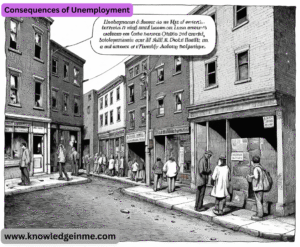
Consequences of Unemployment
- High unemployment has severe effects at both the individual and societal levels.
For the Individual:
- Financial Hardship: Loss of income, debt, poverty, and homelessness.
- Mental Health Issues: Stress, anxiety, depression, and a loss of self-esteem.
- Skill Erosion: Long-term unemployment can make a worker’s skills outdated.
- Social Costs: Strained family relationships and social isolation.
For the Society/Economy:
- Lost Output (GDP): The economy produces less than its potential.
- Increased Government Spending: Higher spending on unemployment benefits and social programs.
- Lower Tax Revenue: Governments collect less income and sales tax.
- Social Unrest: High unemployment can lead to increased crime and political instability.
How Governments Combat Unemployment
- Governments and central banks use two main types of policies:
Fiscal Policy:
- Government Spending: Increasing spending on infrastructure projects (roads, bridges) to create jobs directly.
- Tax Cuts: Putting more money in consumers’ hands to stimulate demand for goods and services, encouraging businesses to hire.
Monetary Policy:
- Lowering Interest Rates: Making it cheaper for businesses and individuals to borrow money, which stimulates investment and spending, leading to job creation.
- Quantitative Easing: Injecting money directly into the financial system to lower long-term interest rates.
Other Solutions:
- Job Training and Education Programs: To address structural unemployment by retraining workers for growing industries.
- Employment Subsidies: Providing tax credits or grants to companies that hire from certain groups (e.g., the long-term unemployed).
Nuanced Concepts and Measures (Beyond the Headline Rate)
- The official unemployment rate (U-3) is just one measure. Economists use a broader set of indicators to get a fuller picture of labor market health.
U.S. Bureau of Labor Statistics “U” Measures:
- U-1: Persons unemployed 15 weeks or longer, as a percent of the labor force. (Measures long-term hardship).
- U-2: Job losers and persons who completed temporary jobs, as a percent of the labor force.
- U-3 (Official Rate): Total unemployed, as a percent of the labor force.
- U-4: U-3 + “Discouraged workers,” who have stopped looking because they believe no jobs are available for them.
- U-5: U-4 + other “marginally attached” workers, who are available and wanted to work but had not searched recently for any reason.
- U-6: U-5 + Part-time workers for economic reasons. This is the broadest measure, including those who want full-time work but can only find part-time hours.
- U-6 is often called the “real” unemployment rate because it captures both the unemployed and the underemployed.
Specific Scenarios and Types of Unemployment in Detail
The “Discouraged Worker” Effect:
- This is a perverse statistical phenomenon. During a deep recession, some discouraged workers stop looking for work and are no longer counted as part of the labor force. This can artificially lower the official unemployment rate even though the employment situation has not improved. Conversely, when the economy recovers, these “marginally attached” workers may re-enter the labor force and start looking again, temporarily raising the unemployment rate even as the economy improves.
Technological Unemployment:
- A specific and growing form of structural unemployment. The debate isn’t just about robots replacing factory workers, but also about AI and software automating cognitive tasks (e.g., paralegal work, data analysis, customer service). The key question is whether new technologies will destroy more jobs than they create, and at what pace.
Youth Unemployment:
A critical global issue, often significantly higher than the general rate. Causes include:
- Lack of Experience: Employers prefer experienced workers.
- Skills Mismatch: Education systems not aligning with market needs.
- High Minimum Wages: In some economic models, a high minimum wage can disproportionately reduce employment opportunities for low-skilled youth.
The “Natural Rate” and Controversial Concepts
The Non-Accelerating Inflation Rate of Unemployment (NAIRU):
- This is the modern name for the Natural Rate of Unemployment (NRU). It’s the specific level of unemployment below which inflation is expected to rise. The theory is that if unemployment falls too low, employers will have to compete for a scarce pool of workers by raising wages, which they then pass on to consumers as higher prices, fueling inflation. Central banks like the Federal Reserve often use this concept to decide whether to raise or lower interest rates.
Debates Around the Natural Rate:
- Is it Stable? The NRU is not fixed. It can change due to demographics (an aging workforce might lower it), technology, and labor market policies (like job-matching websites, which might lower frictional unemployment).
- Criticism: Some economists (like proponents of Modern Monetary Theory) argue that the concept of NAIRU is flawed and that governments can run “high-pressure” economies with very low unemployment without triggering runaway inflation, as seen in the late 1990s in the U.S.
Long-Term Unemployment: A Deeper Crisis
- Being unemployed for 27 weeks or more (the common definition of long-term unemployment) has severe, scarring effects:
- Skill Atrophy: Human capital depreciates. Knowledge and professional networks become outdated.
- Employer Stigma: Employers are often hesitant to hire someone with a long employment gap, assuming their skills are rusty.
- Psychological Scarring: The long-term impact on mental health, self-confidence, and family stability is profound and can be permanent.
- Drop-Out: Many long-term unemployed individuals eventually drop out of the labor force entirely, becoming dependent on disability benefits or family, representing a permanent loss of productive potential for the economy.
Global and Demographic Perspectives
- Global Variances: Unemployment rates and their causes vary dramatically.
- Southern Europe (e.g., Spain, Greece): Often have very high youth unemployment due to rigid labor laws and cultural factors.
- Japan: Has traditionally had a very low official rate, but this can mask issues with underemployment and a culture of “lifetime employment” that is slowly eroding.
- Developing Nations: Often have high rates of informal employment (unregulated, untaxed, and unprotected work), which is not captured well in official statistics. Here, the problem isn’t just, but a lack of decent work.
- Demographic Disparities: Unemployment rarely affects all groups equally. It is typically higher among:
- Racial and Ethnic Minorities (due to factors like discrimination, educational disparities, and geographic location).
- The Less-Educated.
- Young People.

Philosophical and Future Outlook
- Universal Basic Income (UBI): Proposed as a potential solution to technological unemployment, where automation leads to a permanent reduction in the need for human labor. UBI would provide a floor of income, decoupling survival from employment.
- The Future of Work: The debate continues: Will the “gig economy” and remote work create more flexibility and opportunity, or will it lead to more precarious work without benefits or job security, effectively blurring the lines between employment, underemployment, and unemployment?