
Freedom of speech Of course. “Freedom of speech” is a foundational principle in democratic societies, but it is also one of the most complex and frequently debated. Here’s a comprehensive breakdown of what it means, its philosophical foundations, its limits, and the modern challenges it faces.
What is Freedom of Speech?
- At its core, freedom of speech is the right to express one’s opinions and ideas without fear of government retaliation or censorship. It is considered a fundamental human right and is protected by the constitutions and laws of many nations, as well as by international declarations.
Key Components:
- Freedom of Expression: This is a broader term that includes not only spoken and written words but also art, music, film, protest, and other forms of communication.
- A Negative Right: It primarily restrains the government from interfering with speech. It does not generally force private companies (like social media platforms) or individuals to host or listen to your speech.
Philosophical Foundations: Why is it So Important?
Freedom of speech is not valued just for its own sake. It serves several vital functions in a healthy society:
- The Pursuit of Truth: Often associated with philosopher John Stuart Mill, this “Marketplace of Ideas” theory posits that when truth and falsehood are allowed to grapple freely, truth will eventually win out. Censorship risks suppressing a valuable truth.
- Self-Governance and Democracy: A democracy requires an informed citizenry to make sound decisions. For voters to hold their leaders accountable, they must be able to freely discuss, criticize, and debate government policies.
- Individual Autonomy and Self-Fulfillment: The ability to express oneself is central to human dignity, identity, and intellectual and moral development.
- A Check on Abuse of Power: A free press and open public discourse are essential for exposing corruption, injustice, and malfeasance.
Legal Protections (Examples)
- United States: The First Amendment to the U.S. Constitution is one of the strongest protections for free speech in the world. It states: “Congress shall make no law… abridging the freedom of speech, or of the press.” U.S. courts have interpreted this to provide very broad protection, including for hate speech and offensive expression.
- International Law: The Universal Declaration of Human Rights (Article 19) and the International Covenant on Civil and Political Rights (Article 19) both enshrine freedom of opinion and expression as fundamental human rights.
- Other Countries: Many democracies have strong free speech protections but often balance them more explicitly with other rights, such as dignity and public safety, leading to different legal landscapes (e.g., laws against hate speech in Germany and Canada).
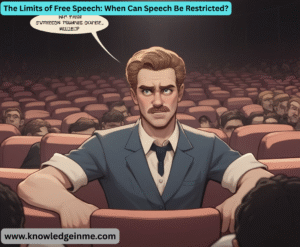
The Limits of Free Speech: When Can Speech Be Restricted?
- No right is absolute. Nearly all legal systems recognize that freedom of speech can be limited in certain, narrowly defined circumstances. The classic example is that you cannot falsely shout “Fire!” in a crowded theater, causing a deadly panic.
Common categories of unprotected or restrictable speech include:
- Incitement to Imminent Lawless Action: Speech that is likely to provoke immediate violence or illegal activity (the “imminent lawless action” test from Brandenburg v. Ohio in the U.S.).
- Defamation: Knowingly false statements of fact that harm someone’s reputation (libel for written statements, slander for spoken ones).
- Obscenity: In some jurisdictions, a narrow category of sexually explicit material that meets a specific legal test (e.g., the Miller test in the U.S.).
- True Threats: Statements that communicate a serious intent to commit an act of unlawful violence against a particular individual or group.
- Fighting Words: Face-to-face personal insults that are likely to provoke an immediate violent reaction (this category is narrowly applied in the U.S.).
- Child Sexual Abuse Material (CSAM): The creation and distribution of this material is universally illegal.
- Perjury: Lying under oath in a court of law.
Modern Challenges and Debates
The digital age has transformed the free speech landscape, creating new and difficult questions:
- Social Media and Censorship: Should private platforms like Facebook, X (Twitter), and YouTube be considered “modern public squares”? Do their content moderation policies constitute a form of private censorship, and should they be regulated by governments?
- Hate Speech vs. Free Speech: Where is the line between offensive political commentary and hate speech that incites violence or discrimination against a protected group? The U.S. generally protects hate speech, while the European Union and many other countries have laws criminalizing it.
- Misinformation and Disinformation: How should societies deal with the rapid spread of demonstrably false information that can undermine public health (e.g., during a pandemic) or democratic processes (e.g., election fraud claims)?
- “Cancel Culture”: The debate around social and professional consequences for speech deemed offensive. Is this a form of democratic accountability or a mob-driven suppression of unpopular views?
- Algorithmic Amplification: Social media algorithms are designed to maximize engagement, which often means promoting controversial, emotional, or extreme content. This can distort public discourse in ways the original framers of free speech principles could never have imagined.
Key Philosophical Tensions in Practice
The theoretical foundations often clash in real-world scenarios, creating enduring tensions:
- The Tolerance Paradox (Popper’s Paradox): Can a tolerant society tolerate intolerance? If unlimited tolerance is extended to intolerant groups, they may eventually destroy the tolerant society itself. This is a central argument for placing limits on hate speech and extremist ideologies.
- Negative vs. Positive Rights: The classic liberal view sees free speech as a negative right (the government must leave you alone). A more modern, progressive view argues for it as a positive right—that true freedom of expression requires the government to ensure all voices can be heard, which might involve regulating platforms to ensure equitable access or funding diverse media.
- Liberty vs. Equality: This is the heart of the hate speech debate. The principle of liberty argues for maximal speech, even if it’s offensive. The principle of equality argues that hate speech silences and marginalizes vulnerable groups, effectively denying them equal participation in society. Different legal systems prioritize one over the other.
The Global Perspective: A Comparative Look
The U.S. model is an outlier in its permissiveness. Comparing it to other democracies is instructive:
- United States: The “First Amendment Absolutist” model. The government’s power to restrict speech is extremely limited. Hate speech, however vile, is protected unless it directly incites imminent violence.
- Germany: The “Militant Democracy” model. Having learned from the Nazi era, Germany actively defends its democratic order. It criminalizes Holocaust denial and incitement of hatred against segments of the population. The state has a duty to combat speech that threatens human dignity.
- Canada: The “Balanced” model. This leads to laws against willful promotion of hatred.
- United Kingdom: A mix of common law and statute. Has laws against “hate speech” and “incitement to racial hatred,” and strictly regulates broadcast media through Ofcom.
The Digital Public Square: The Central Modern Challenge
- This is where the most intense battles are now fought. The key problem is that the rules are set by private corporations, not governments.
The “Platform vs. Publisher” Debate:
- Platform Argument: Social media companies are neutral conduits of information, like a telephone company. They shouldn’t be held liable for what users say, which is the legal framework under Section 230 of the U.S. Communications Decency Act.
- Publisher Argument: By actively curating, moderating, and algorithmically promoting content, they are acting like publishers and should bear the same legal responsibilities as a newspaper.
- Content Moderation Dilemmas: Platforms face impossible choices:
- Too much moderation: Accusations of political bias and censorship.
- Too little moderation: Platforms become overrun with spam, harassment, and misinformation, driving away users.
- Deplat forming: Is removing a controversial figure (like a former president) from a major platform a responsible act of safety or a dangerous concentration of power?
Emerging Frontiers
The concept of “speech” is expanding, creating new legal and ethical questions:
- Campaign Finance: Is spending money on political advertising a form of speech? The U.S. Supreme Court, in Citizens United, said yes, treating corporate spending as protected political speech.
- AI and Algorithmic Speech: When an AI generates content, who is the speaker? Who is liable for defamation or misinformation spread by an AI? Are search engine results a form of speech protected from government regulation?
- Data as Speech: Is providing a link to hacked or stolen data (like in the WikiLeaks case) an act of free speech?
- Compelled Speech: This involves forcing an individual or organization to express a message they disagree with. This is at the heart of debates over:
- Mandatory pronoun use.
- Website designers being forced to create sites for same-sex weddings.
- Warning labels on certain products.