
Homeostasis Homeostasis is the ability of an organism or system to maintain a stable and constant internal environment, despite changes in external conditions. It is a fundamental concept in biology, essential for the survival of all living things. It’s not about being static and unchanging, but rather about maintaining a dynamic equilibrium. Think of it like a tightrope walker constantly making small adjustments to stay balanced.
The Core Principle: The Feedback Loop
- Homeostasis is primarily achieved through feedback loops. These are circular processes in which the body senses a change, processes that information, and reacts to reverse the change. The most common type is the negative feedback loop.
The Negative Feedback Loop (The Most Common Mechanism)
- This loop works to reduce the effect of a stimulus, thereby reversing the change and bringing the system back to its set point (the desired level).
It has three key components:
- Receptor/Sensor: Monitors the environment and detects a change in a specific variable (e.g., temperature, blood sugar).
- Control Center: Receives information from the receptor, compares it to the set point, and determines the appropriate response. (Often the brain or an endocrine gland).
- Effector: The organ or gland that carries out the response to correct the imbalance.
Classic Examples of Homeostasis in the Human Body
Thermo regulation (Maintaining Body Temperature)
Set Point: ~37°C (98.6°F)
- Scenario: You go for a run on a hot day.
- Stimulus: Body temperature rises above 37°C.
- Receptor: Temperature sensors in the skin and brain detect the increase.
- Control Center: The hypothalamus in the brain processes the information.
Effector/Response:
- Sweat glands produce sweat. As it evaporates, it cools the skin.
- Blood vessels near the skin dilate (vasodilation), allowing more blood to flow near the surface to release heat.
- Result: Body temperature decreases back to the set point.
- The opposite happens when you are cold: you shiver (to generate heat) and your blood vessels constrict (to conserve heat).
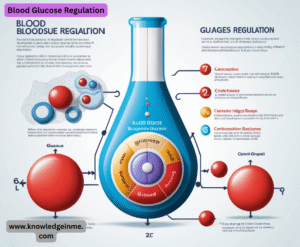
Blood Glucose Regulation
- Set Point: ~90 mg/100 mL of blood
- Scenario: You eat a sugary meal.
- Stimulus: Blood glucose levels rise.
- Receptor: Beta cells in the pancreas detect high glucose.
- Control Center: The pancreas.
- Effector/Response: The pancreas releases insulin. Insulin tells cells throughout the body to absorb glucose from the bloodstream.
- Result: Blood glucose levels decrease back to the set point.
- The opposite happens when you haven’t eaten: the pancreas releases glucagon, which tells the liver to release stored glucose, raising blood sugar levels.
Osmo regulation (Maintaining Water Balance)
- Set Point: Stable blood pressure and water/salt concentration.
- Scenario: You eat a very salty bag of chips.
- Stimulus: The concentration of salts in your blood increases, threatening to dehydrate your cells.
- Receptor: Osmoreceptors in the hypothalamus detect the high solute concentration.
- Control Center: The hypothalamus and pituitary gland.
- Effector/Response: The pituitary gland releases Antidiuretic Hormone (ADH). ADH tells the kidneys to reabsorb more water back into the bloodstream.
- Result: You produce less, but more concentrated, urine. Water is conserved, and blood concentration returns to normal.
Positive Feedback Loop (The Less Common Mechanism)
- Unlike negative feedback, positive feedback amplifies the original stimulus, pushing the system further away from its starting point. These are typically used for processes that need to reach a swift completion and are not used for continuous regulation.
Example: Childbirth
- Stimulus: The baby’s head presses against the cervix.
- Receptor: Nerves in the cervix send signals to the brain.
- Control Center: The pituitary gland in the brain.
- Effector/Response: The pituitary releases oxytocin, which intensifies uterine contractions.
- Result: Stronger contractions push the baby harder against the cervix, which stimulates more oxytocin release. This loop continues until the baby is born (the process is complete).
- Other Examples: The blood clotting cascade and the generation of nerve signals (action potentials).
Why is Homeostasis Important?
- Without homeostasis, an organism’s internal environment would be subject to the whims of the external environment. Enzymes, which control all biochemical reactions, are extremely sensitive to conditions like temperature and pH. Even small deviations can cause them to denature and stop functioning, leading to cell death and ultimately, the death of the organism.
The Bigger Picture: Homeostasis as a Foundational Principle
Homeostasis isn’t just a biological process; it’s a fundamental principle of complex systems. The concept can be applied to:
- Ecology: An ecosystem maintains homeostasis through predator-prey relationships, nutrient cycling, and succession. For example, a rise in the prey population leads to a rise in predators, which then brings the prey population back down.
- Psychology: The body seeks to maintain psychological equilibrium. The concept of cognitive homeostasis explains how we reduce “cognitive dissonance” (mental discomfort) by changing our beliefs or attitudes to restore internal consistency.
- Technology: A thermostat is a mechanical homeostatic system. So is the cruise control in your car. Your body’s insulin response is analogous to a smart grid that manages energy supply and demand.
Advanced Biological Examples
Calcium Homeostasis
- Calcium is critical for nerve transmission, muscle contraction, and bone strength. Its level in the blood is tightly controlled.
- Set Point: ~10 mg/100 mL of blood.
Stimulus (Low Calcium):
- Receptor: Parathyroid glands detect low blood calcium.
- Control Center: Parathyroid glands.
- Effector/Response: Release Parathyroid Hormone (PTH).
- PTH stimulates bones to release calcium.
- PTH tells kidneys to reabsorb more calcium from urine.
- PTR activates Vitamin D, which increases calcium absorption from the gut.
Stimulus (High Calcium):
- Receptor: Thyroid gland detects high blood calcium.
- Control Center: Thyroid gland.
- Effector/Response: Releases Calcitonin.
- Calcitonin inhibits calcium release from bones and encourages its deposition.
- It also reduces kidney reabsorption of calcium.
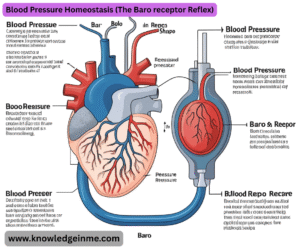
Blood Pressure Homeostasis (The Baro receptor Reflex)
- This is a very fast-acting neural feedback loop.
- Scenario: You stand up quickly.
- Stimulus: Gravity pulls blood down to your legs, causing a momentary drop in blood pressure in your head.
- Receptor: Baroreceptors in the carotid sinus and aortic arch detect the pressure drop.
- Control Center: The cardiovascular center in the medulla oblongata (brainstem).
Effector/Response:
- The brain signals the heart to beat faster and more forcefully (increases heart rate and contractility).
- It signals blood vessels to constrict (vasoconstriction), increasing peripheral resistance.
- Result: Blood pressure is rapidly restored, preventing fainting.
Key Concepts for a Deeper Understanding
Dynamic Equilibrium is Key
- Homeostasis is not a fixed, rigid state. It’s a dynamic range within which the body can fluctuate and still be healthy. For example, your body temperature can be 36.5°C or 37.2°C and still be considered normal. The system is constantly making tiny adjustments.
The Concept of Allostasis
- This is a more modern and nuanced extension of homeostasis.
- Homeostasis: The body works to maintain stability through constancy.
- Allostasis: The body works to maintain stability through change. It’s the process of achieving stability by actively anticipating needs and adjusting the body’s “set points” in response to stress.
- Example: Before a big race, your brain (via the HPA axis – Hypothalamic-Pituitary-Adrenal axis) will proactively release cortisol and adrenaline. This doesn’t reverse a change; it anticipates a demand and changes your internal state (e.g., raising heart rate and blood sugar) to meet the challenge. The cost of this repeated adjustment is called allostatic load.
What Happens When Homeostasis Fails?
- Homeostatic imbalance is the basis for most disease and aging.
- Diabetes Type 1: The pancreas fails to produce insulin (failure of the effector), destroying the negative feedback loop for blood sugar.
- Heat Stroke: The thermoregulatory system becomes overwhelmed. Sweating stops, and the body temperature soars, leading to a dangerous positive feedback loop where high temperature damages the hypothalamus, making it even harder to cool down.
- Heart Failure: The heart (effector) can no longer pump blood effectively, disrupting homeostatic control of blood pressure, fluid balance, and oxygen delivery.
- Aging: Over time, the efficiency of receptors, control centers, and effectors declines. An older person has a less responsive baroreceptor reflex, making them more prone to dizziness when standing up.