

Artificial Intelligence and Digital Content Of course. This is a fascinating and rapidly evolving topic. Here’s a comprehensive breakdown of this relationship.
The Core Synergy: A New Paradigm
- At its heart, AI acts as a powerful force multiplier for digital content.
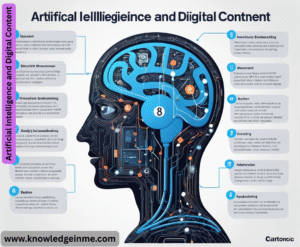
The synergy can be visualized as a cycle:
- AI Creates & Optimizes Content → Content Generates User Data → AI Analyzes Data → AI Personalizes & Improves Future Content
AI in Content Creation
- This is the most visible application, often referred to as Generative AI.
Text Generation:
- Tools: ChatGPT, Claude, Jasper, Copy.ai
- Applications: Writing articles, blog posts, social media captions, marketing copy, product descriptions, and even code.
- Impact: Dramatically speeds up the writing process, helps overcome writer’s block, and allows for A/B testing of messaging at scale.
Image and Art Generation:
- Tools: Midjourney, DALL-E, Stable Diffusion
- Applications: Creating original illustrations, concept art, marketing visuals, social media graphics, and stock photos.
- Impact: Democratizes visual creation, reduces costs for stock imagery and custom art, and enables rapid prototyping of visual ideas.
Audio and Music Generation:
- Tools: OpenAI’s Jukebox, AIVA, Suno, Murf.ai
- Applications: Composing royalty-free background music, generating sound effects, and creating synthetic voices for narration.
- Impact: Provides affordable and unique audio for videos, podcasts, and games.
Video Generation and Editing:
- Tools: Sora, Runway, Pika Labs, Descript
- Applications: Generating short video clips from text prompts, automating video editing (cutting silences, adding B-roll), deepfake technology, and upscaling resolution.
- Impact: Significantly lowers the barrier to entry for high-quality video production.
Content Management and Optimization
doesn’t just create; it helps organize and improve content.
- Automated Tagging and Metadata: AI can analyze content (images, text, video) and automatically generate relevant tags, keywords, and descriptions, making content libraries easily searchable.
- Search and Discovery: AI-powered search engines (like Google’s MUM) understand user intent and semantic meaning, delivering more relevant results. Netflix and YouTube use AI to power their recommendation engines.
- SEO (Search Engine Optimization): AI tools analyze top-ranking content, suggest keywords, and help optimize articles to better align with search engine algorithms.
- Content Moderation: Platforms like Facebook and YouTube use AI to identify and flag harmful content (hate speech, violence, spam) at a scale that human moderators cannot match.
Content Personalization and Distribution
This is where AI ensures the right content reaches the right user at the right time.
- Recommendation Engines: The algorithms behind “Because you watched…” on Netflix or “You might also like…” on Amazon are classic examples of AI driving engagement through personalization.
- Dynamic Email Marketing: AI can personalize email subject lines and content for individual subscribers based on their past behavior to increase open and click-through rates.
- Artificial Intelligence and Digital Content Programmatic Advertising: AI automates the buying and placement of ads, targeting users with hyper-relevant content based on their demographics, interests, and online behavior.

AI in Content Analytics and Insight
AI turns content consumption into actionable business intelligence.
- Sentiment Analysis: AI can scan social media comments, reviews, and articles to gauge public sentiment about a brand, product, or topic.
- Content Performance Analysis: AI tools go beyond basic metrics (views, likes) to provide insights into why certain content performs better, predicting future trends and content gaps.
- Competitive Analysis: AI can monitor and analyze competitors’ content strategies, providing a benchmark and revealing opportunities.
The Challenges and Ethical Considerations
The integration of AI and digital content is not without its significant challenges:
- Copyright and Intellectual Property: Who owns the copyright to an image generated by an AI that was trained on millions of copyrighted artworks? This is a major, unresolved legal battle.
- Bias and Fairness: AI models can perpetuate and even amplify societal biases present in their training data, leading to unfair or discriminatory content.
- Misinformation and Deepfakes: AI makes it incredibly easy to create convincing fake news, fraudulent content, and malicious deepfakes, posing a threat to trust and society.
- Job Displacement: There is a legitimate concern that AI will automate roles traditionally held by writers, graphic designers, and musicians.
- Authenticity and the “Human Touch”: An over-reliance on AI-generated content can lead to a homogenized digital landscape, lacking the unique perspective and emotional depth that comes from human experience.
- Content Quality and “Hallucinations”: Generative AI can produce plausible-sounding but factually incorrect or nonsensical information (called “hallucinations”), requiring rigorous human fact-checking.
The Future: A Collaborative Human-AI Partnership
- The future is not about AI replacing humans, but about humans using AI as a collaborative tool.
- The writer will use AI to brainstorm ideas and draft outlines, then apply their unique voice and insight to refine the final piece.
- The marketer will use AI to generate 100 ad variations, then select and tweak the top 5 that resonate best.
- The filmmaker will use AI to generate storyboards and concept art, accelerating the pre-production process.
Deep Dive: Emerging Frontiers and Advanced Applications
Beyond the basics, AI is enabling entirely new forms of content and workflows.
Dynamic & Interactive Content
AI is making content fluid and responsive to individual users in real-time.
- Procedural Generation: In gaming, AI like NVIDIA’s DLSS or in-game engines generates endless, unique environments, levels, and storylines (e.g., No Man’s Sky). This creates a unique experience for every player.
- Interactive Stories & Choose-Your-Own-Adventure: Platforms like Netflix have experimented with this, but AI can take it further by dynamically generating narrative branches and dialogue based on a user’s choices, making them truly unique.
- Artificial Intelligence and Digital Content Personalized Video: Imagine a product marketing video where the spokesperson says your name, shows your industry, and highlights features relevant to your company—all generated automatically by AI.
The Semantic Web and “Intelligent” Content
AI is helping structure content so machines can understand its meaning, not just humans.
- Knowledge Graphs: AI helps build and connect vast networks of information (like Google’s Knowledge Panel). Content isn’t just a string of text; it’s a node in a web of related entities, facts, and concepts.
- Automated Summarization & Translation: AI can create concise summaries of long reports (TL;DR) and provide near-instant, context-aware translation, breaking down language barriers for global content.
Content Lifecycle Management (CLM)
manages the entire lifespan of content, from ideation to archiving.
- Content Gap Analysis: AI tools can scan the entire web, identify topics your audience is searching for that you haven’t covered, and suggest new content pillars.
- Automated A/B Testing: AI can run multivariate tests on headlines, images, and CTAs simultaneously, learning which combinations drive the most conversions and automatically serving the winner.
- Content Repurposing: An AI can take a core webinar transcript and automatically turn it into a blog post, a series of social media snippets, a newsletter email, and a script for a short TikTok video.
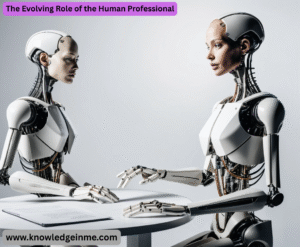
The Evolving Role of the Human Professional
The fear of replacement is giving way to a model of augmentation. Here’s how roles are transforming:
- The Writer/Editor → The “AI Editor-in-Chief”: The human role shifts from drafting every word to:
- Prompt Engineering: Crafting precise, creative instructions to guide the AI.
- Curating & Synthesizing: Selecting the best output from multiple AI generations.
- Fact-Checking & Verifying: Combating AI “hallucinations” and ensuring accuracy.
- Adding Voice & Emotion: Infusing the text with unique style, humor, and strategic nuance that AI lacks.
The Designer → The Creative Director:
- Conceptualizing: Providing the creative vision and artistic direction.
- Iterating at Speed: Using AI to generate 50 mood boards or logo concepts in minutes instead of days.
- Refining & Perfecting: Using AI-powered tools in Photoshop (e.g., Generative Fill) to execute complex edits effortlessly, focusing on high-level composition.
The Marketer → The Data-Driven Strategist:
- Orchestrating Campaigns: Using AI insights to plan omnichannel strategies.
- Interpreting Deep Analytics: Moving beyond surface-level metrics to understand the “why” behind user behavior predicted by AI.
- Managing the AI Toolkit: Overseeing a suite of AI tools for SEO, personalization, and analytics.
The Geopolitical and Structural Impact
The AI-Content revolution is having broader consequences:
- Artificial Intelligence and Digital Content The Democratization of Creation: High-quality content creation is now accessible to individuals and small businesses without large budgets, challenging the dominance of large media companies.
- There’s a emerging gap between those who have access to the most powerful AI models (large corporations) and those who use API-based services. This could centralize power in the tech giants that control the core AI infrastructure.
The Future: Speculative and Imminent Trends
- The Agentive Future: AI won’t just be a tool you command; it will be an agent that acts on your behalf.
- Multimodal Generation as Standard: The distinction between text, image, and video AIs will blur.
- Generative UI/UX: User interfaces could become dynamic.
- The Regulation Wave: Governments will inevitably step in with laws governing AI-generated content, requiring watermarks for deepfakes, and establishing new copyright frameworks. The EU’s AI Act is a leading example.
- The Search for “Authenticity”: As synthetic content becomes ubiquitous, we may see a cultural and technological backlash.