

Practice Regularly Of course! “Practice Regularly” is simple advice, but it’s the cornerstone of mastery in any skill, from playing the violin to coding to public speaking. The key is to move from the vague idea of “practicing regularly” to a structured, effective system. Here’s a comprehensive guide on how to do just that.

The Foundation: Why “Regularly” Beats “A Lot”
- Neural Pathways: Consistent practice strengthens the neural pathways in your brain related to the skill. Irregular, crammed practice is less efficient at building these strong connections.
- The Forgetting Curve: If you wait too long between sessions, you’ll spend valuable time re-learning what you already covered. Regular practice fights this curve.
- Momentum and Habit: Doing a little bit often is easier to turn into a habit. It reduces the mental resistance (“I don’t feel like it today”) that comes with infrequent, marathon sessions.
- Compound Effect: Small, daily improvements compound into massive growth over time.
How to Build a “Practice Regularly” System
Set a Clear, Actionable Goal
- Instead of: “I want to get better at guitar.”
- Try: “I will learn to play the chorus of [Song Name] smoothly at 80 BPM by the end of the month.”
- SMART Goals work best: Specific, Measurable, Achievable, Relevant, Time-bound.
Schedule It (Time and Duration)
- Be Realistic: Don’t say you’ll practice for 2 hours daily if you’ve never done it before. Start with 15-25 minutes.
- Time of Day: Link it to an existing habit. “Right after my morning coffee, I will practice for 20 minutes.” This is called habit stacking.
- Put it in Your Calendar: Treat it like an important meeting you can’t miss.
Structure Your Practice Sessions
- A haphazard session is less effective than a focused one. Use this template:
- Warm-Up (5-10% of time): Review something you know well. Get your mind and muscles into the right mode.
- Focus on the Hard Part (60-70% of time): This is the core of improvement. Work deliberately on the specific skill or passage that is challenging you. Slow it down. Break it into tiny pieces.
- Play/Apply (20-30% of time): Use the new skill in a fun way. If you’re learning a language, try to have a mini-conversation. If you’re coding, build a small, fun project. This reinforces learning and maintains motivation.
- Cool-Down & Reflect (5% of time): What went well? What was difficult? Jot down one note for your next session.
Embrace Deliberate Practice
- This is the secret sauce. It’s not just repeating something mindlessly.
- Get Out of Your Comfort Zone: You must be working on tasks that are slightly beyond your current ability.
- Full Focus and Concentration: No multitasking. Put your phone away.
- Immediate Feedback: Use a metronome, record yourself, get a coach, or use an app that tells you if you’re right or wrong.
- Identify Weaknesses: Constantly analyze where you are failing and design exercises to target those specific points.
Strategies to Stay Consistent
- Don’t Break the Chain: Get a calendar and put a big red “X” on every day you complete your practice. The visual chain of X’s is powerfully motivating.
- Track Your Progress: Keep a practice journal. Looking back at how far you’ve come is a huge motivator on days you feel stuck.
- Forgive Yourself and Restart: You will miss a day. Maybe a week. Do not let this derail you. The goal is consistency, not perfection. Just get back to it the next day. Don’t fall for the “all-or-nothing” trap.
- Find an Accountability Partner: Tell a friend your goal or join a community. Knowing someone else expects an update can push you through low-motivation days.

Example in Action: Learning a Language
- Vague Plan: “I should practice Spanish more.”
Effective “Practice Regularly” Plan:
- Goal: Hold a 3-minute conversation about my family by the end of the month.
- Schedule: 20 minutes, every weekday during my lunch break.
Session Structure:
- Warm-up (3 mins): Review flashcards of family member vocabulary.
- Focus (12 mins): Use a language app to learn and practice the sentence structure for describing people (e.g., “My brother is tall and funny”). Record myself saying these sentences and listen back.
- Play (5 mins): Watch a short clip of a Spanish show and try to pick out the words I know.
- Tracking: Mark my calendar and write one new sentence I learned in my journal.
Advanced Concepts: The “Why” Behind the Method
The Zone of Proximal Development (ZPD)
- This is a crucial concept from educational psychology.
- What it is: The space between what you can do alone and what you can do with guidance. This is the sweet spot for learning.
- Application: Your practice should constantly live in your ZPD. If it’s too easy, you’re bored. If it’s too hard, you’re frustrated. Use a teacher, a tutorial, or a structured method to help you tackle things just beyond your current ability.
The Dreyfus Model of Skill Acquisition
- Understand the stages you’re moving through. This helps you be patient with the process.
- Novice:Needs clear rules. (“Place your fingers here.”)
- Advanced Beginner: Starts to handle situational aspects. (“This sounds a bit off, I’ll adjust my finger.”)
- Competent: Can formulate their own plans and routines. (“I’ll work on this scale for 10 minutes, then apply it to this song.”)
- Proficient: Learns from experience and can self-correct. (“That sounded bad because my wrist was tense.”)
- Expert: Has an intuitive grasp and can innovate. (Plays with feeling and improvises effortlessly.)
- Your practice strategy should evolve as you move through these stages. Novices need more structure; experts need more challenging, creative problems.
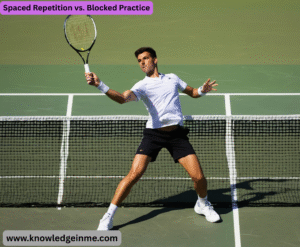
Spaced Repetition vs. Blocked Practice
- Blocked Practice: Doing the same thing over and over (e.g., hitting 100 tennis forehands in a row). It feels productive because you improve quickly during the session, but the learning doesn’t stick as well.
- Spaced Repetition: Reviewing material at increasing intervals. This is the foundation of language apps like Anki. It’s brutally effective for memory.
- Interleaving (The Next Level): Mixing up different skills within a single session. Instead of just forehands, you mix forehands, backhands, and volleys randomly. It feels harder and more frustrating, but it leads to much better long-term learning and adaptability. Your brain has to work harder to retrieve the right “tool,” strengthening the memory.
The Psychology of Practice: Managing Your Mind
Process Over Outcome
- Outcome Goal: “I want to win the competition.” (This can create anxiety and is outside your full control.)
- Process Goal: “I will complete my full, focused 45-minute practice routine today.” (This is 100% within your control.)
Focus on the process. The outcomes will follow.
Embrace the “Suck”
- There will be plateaus. Progress is not a straight line. It looks more like this:
- Rapid Initial Growth -> The Plateau -> The Dip -> A Sudden Breakthrough -> A New Plateau
Understanding that “The Dip” is a natural part of the process prevents you from quitting when it feels like you’re not improving.
The Power of Mindfulness in Practice
- Practice is not just physical or intellectual; it’s also perceptual.
- Beginner’s Mind (Shoshin): Approach each practice session with curiosity, as if you are a beginner. This helps you notice subtle details you might otherwise ignore.
- Body Scanning: Are you tense? Is your breathing shallow? High performance requires awareness of the body and mind connection. A tense body learns poorly.
Motivation follows Action
- Don’t wait to feel motivated. The act of starting the practice itself generates motivation. The key is to make the barrier to starting as low as possible. (e.g., “I’ll just do 5 minutes” often turns into a full session.)