

General Databases Of course. Here is a comprehensive overview of General Databases, covering what they are, their types, core concepts, and modern trends.

What is a Database?
- Think of it as a digital filing cabinet where data is stored in a highly organized way, making it easy to find, manage, and update.
Relational Databases (SQL)
- This is the most common and established type.
- ACID Compliance: They emphasize ACID properties (Atomicity, Consistency, Isolation, Durability) to guarantee data validity despite errors or failures.
Non-Relational Databases (NoSQL)
- They emerged to handle the scale, speed, and variety of data that modern web applications generate.
They are further divided into several types:
- Document Databases: Store data in document-like structures (e.g., JSON, XML). Each document can have a completely different structure.
- Use Case: Content management systems, user profiles, catalogs.
- Examples: MongoDB, CouchDB.
- Key-Value Stores: The simplest model.
- Use Case: Session storage, caching, real-time recommendations.
- Examples: Redis, DynamoDB, Memcached.
- Column-Family Stores: Instead of storing data in rows, they store it in columns. This is optimized for queries over large datasets.
- Use Case: Analytical platforms, big data applications.
- Examples: Apache Cassandra, HBase.
- Graph Databases: Focus on the relationships between data points. Data is stored in nodes and edges (relationships).
- Use Case: Social networks, fraud detection, recommendation engines.
- Examples: Neo4j, Amazon Neptune.
Core Database Concepts
General Databases. DBMS (Database Management System): The software (e.g., MySQL, MongoDB) that manages the database. It handles tasks like:
- Data storage, retrieval, and update.
- User access control and security.
- Backup and recovery.
- Ensuring data integrity.
- Schema: The blueprint of the database. It defines how the data is organized, including tables, fields, relationships, indexes, and views. In relational databases, the schema is rigid. In many NoSQL databases, the schema is flexible or “dynamic.”
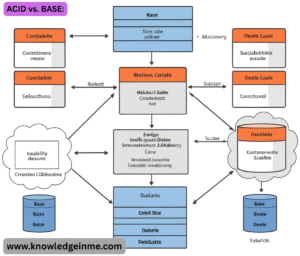
ACID vs. BASE:
BASE (Basically Available, Soft state, Eventual consistency): A model used by many NoSQL databases for high availability and scalability. It prioritizes speed and scale over immediate consistency.
- Create (Insert)
- Read (Select)
- Update
- Delete
Modern Trends & Evolution
- NewSQL: A class of modern relational databases that aim to provide the same scalable performance of NoSQL systems while maintaining the ACID guarantees of traditional SQL databases. Examples: Google Spanner, CockroachDB.
- Cloud Databases: Databases are increasingly offered as a managed service (DBaaS – Database as a Service) by cloud providers like AWS, Google Cloud, and Microsoft Azure.
- Multi-Model Databases: Databases that support more than one data model.This provides flexibility for diverse application needs.
- Examples: Azure Cosmos DB, ArangoDB, OrientDB.
How to Choose a Database?
- There is no “best” database, only the best one for your specific use case. Consider these questions:
- Data Structure: Is your data highly structured and predictable? (Use SQL). Is it unstructured, semi-structured, or changing rapidly? (Use NoSQL).
- Scalability: Do you need to scale vertically (adding more power to a single server) or horizontally (adding more servers)? NoSQL databases are generally designed for horizontal scaling.
- Consistency vs. Availability: Do you need strict data consistency (e.g., for a financial system – SQL), or can you tolerate eventual consistency for higher speed and availability (e.g., for a social media feed – NoSQL)?
- Team Expertise: Is your team more experienced with SQL or a specific NoSQL technology?
- Community & Support: Is the database well-supported, with a strong community and good documentation?
Beyond the Basics: Advanced Concepts & Nuances
Inside a Relational Database: More Than Just Tables
- Indexes: These are data structures (like a book’s index) that drastically speed up data retrieval on a column. However, they slow down writes (INSERT/UPDATE/DELETE). Choosing the right columns to index is a critical performance tuning task.
- Views: Virtual tables created by a saved SQL query. They don’t store data themselves but present data from underlying tables in a specific, often simplified, way. Useful for security (hiding certain columns) and complexity reduction.
- They reduce network traffic (sending one call instead of many queries) and centralize business logic.
- All operations must succeed, or none do. This is where ACID is implemented. Example: transferring money between two bank accounts involves debiting one and crediting another; both must happen.
The CAP Theorem: The Fundamental Trade-off
- This theorem is crucial for understanding distributed systems like modern NoSQL databases. It states that a distributed data store can only simultaneously provide two of the following three guarantees:
- Availability (A): Every request receives a (non-error) response, without the guarantee that it contains the most recent write.
- The Implication: In a networked environment (which always has the potential for partitions, P), you must choose between Consistency (C) and Availability (A).
- CP Databases (e.g., MongoDB, HBase, Redis): Choose consistency over availability.
- They will always accept reads and writes, even during a partition, but you might get stale data.
- CA Databases: Effectively impossible in a distributed system. Traditional single-node RDBMSes are CA, but as soon as you add replication, they have to deal with partitions.
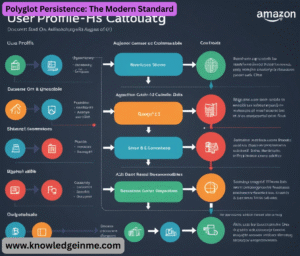
Polyglot Persistence: The Modern Standard
Example: An E-commerce Platform:
- General Databases. User Profiles & Product Catalog: Document Store (MongoDB). Flexible schema is good for evolving product attributes.
- Financial Transactions: Relational Database (PostgreSQL). ACID compliance is non-negotiable for money.
- Shopping Cart & Session Cache: Key-Value Store (Redis). Extremely fast reads/writes for temporary data.
- Product Recommendations: Graph Database (Neo4j). Perfect for “users who bought this also bought…” queries based on relationships.
- Analytics & Data Warehousing: Columnar Store (Amazon Redshift, BigQuery). Optimized for rapidly aggregating large volumes of data.
Operational Considerations: It’s Not Just the Model
Managed vs. Self-Hosted:
- Self-Hosted: You install the DBMS on your own servers (physical or cloud VMs). You have full control but are responsible for all maintenance: backups, patches, scaling, security, and failure recovery.
- Managed (DBaaS): The cloud provider runs the database for you.You lose some low-level control but gain massive operational efficiency. This is the default choice for most new projects.
Replication and Sharding:
- Replication: Creating copies of a database (often across multiple geographic regions).
- Each shard holds a subset of the total data (e.g., user data for users A-M on shard 1, N-Z on shard 2). Used for write scalability.
- The Rise of PostgreSQL: PostgreSQL deserves a special mention. It’s a powerful open-source RDBMS that has become a default choice for many due to its:
- Strong standards compliance and ACID guarantees.
- Extensive feature set (e.g., JSONB support for document-like storage, geospatial data extensions).
- Vibrant ecosystem and community.