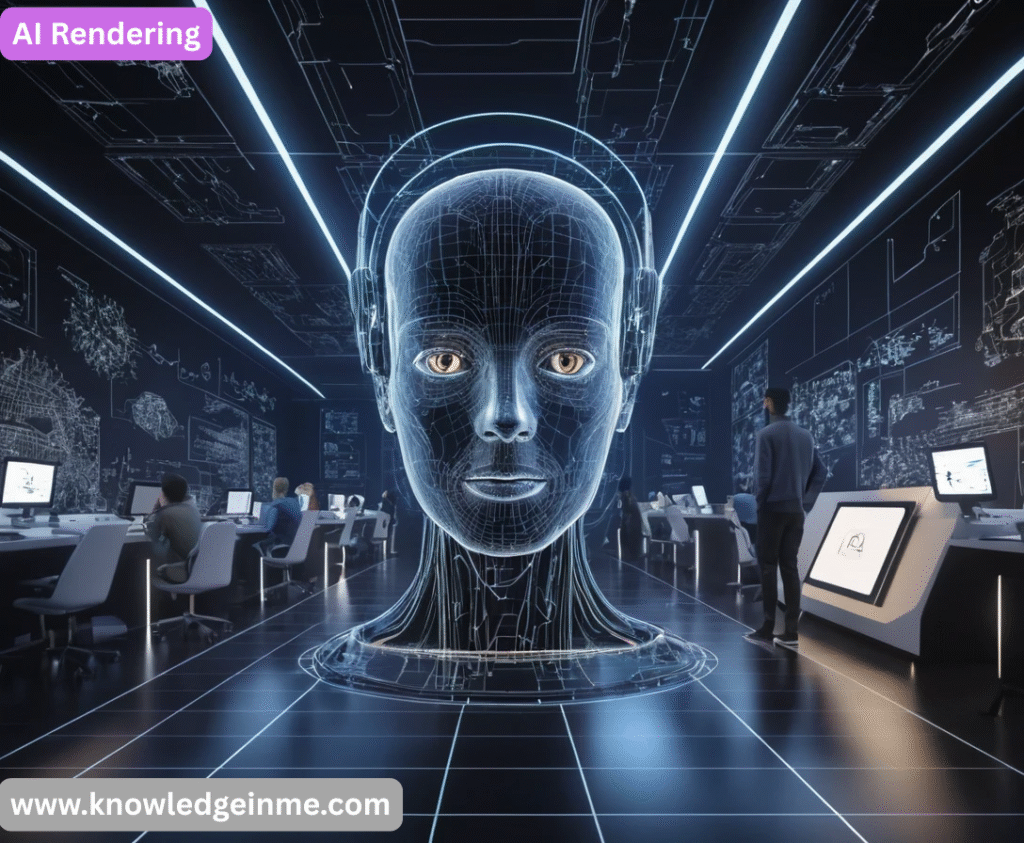

AI Rendering Of course! “AI Rendering” is one of the most transformative and exciting applications of artificial intelligence today. It refers to the use of AI models to generate, enhance, or accelerate the creation of visual imagery, both 2D and 3D.
At its core, AI rendering uses machine learning to understand and replicate the complex patterns of light, texture, and composition that make up a realistic or stylized image.
Here’s a comprehensive breakdown of what AI Rendering entails:
Core Concepts: How It Works
- Instead of calculating the path of millions of light rays using complex physics equations (like traditional CGI), AI rendering relies on models trained on massive datasets of images and their corresponding text descriptions (captions).
- Training: A model (like Stable Diffusion, Midjourney, or DALL-E) is fed billions of image-text pairs. It learns to associate words and concepts with visual features.
- Inference (Generation): When you give the AI a text prompt (e.g., “a cyberpunk cat wearing a neon jacket in a rainy Tokyo street”), it doesn’t “draw” the scene. Instead, it starts with a field of random noise and iteratively “denoises” it, shaping it to match the patterns it learned for the concepts in your prompt.
Key Areas of AI Rendering
- AI rendering isn’t a single thing; it’s a collection of powerful techniques:
A. 2D Image Generation
- This is the most common form, popularized by tools like:
- Midjourney: Known for highly artistic, stylized, and aesthetically pleasing results.
- DALL-E 3 (OpenAI): Excels at understanding complex prompts and generating coherent, detailed images.
- Stable Diffusion (Stability AI): Highly versatile and open-source, allowing for extensive customization, local operation, and fine-tuned control (e.g., through ControlNet).
- Adobe Firefly: Integrated into Creative Cloud, focusing on commercially safe, ethically trained models for designers.
3D Model and Scene Generation
- This is the next frontier, using AI to create 3D assets from scratch or from 2D inputs.
- Text-to-3D: Generating a full 3D model with textures from a text description (e.g., “a low-poly cartoon tree”).
- Image-to-3D: Converting a single 2D image into a 3D model. This was once a very difficult problem that AI is now solving impressively.
- Neural Radiance Fields (NeRFs): A groundbreaking technique that uses a set of 2D photos of an object or scene to reconstruct a photorealistic 3D model that you can view from any angle.
Rendering Acceleration & Enhancement
Here, AI is used to speed up traditional rendering workflows.
- Denoising: In path-traced rendering (used in Blender, V-Ray, etc.), the initial image is very noisy. AI filters can clean up this noise in a fraction of the time it would take to render a clean image, dramatically speeding up workflow.
- Resolution Upscaling: AI can intelligently upscale low-resolution renders to a higher resolution, adding plausible detail instead of just blurring pixels (NVIDIA’s DLSS is a famous example in real-time gaming).
Material and Texture Generation
- AI can generate seamless, high-resolution, and photorealistic textures and materials from a simple text prompt (e.g., “weathered copper with green patina,” “red silk fabric”).
The AI Rendering Workflow (in Practice)
A typical workflow for a creator might look like this:
- Concepting & Mood Boards: Use a tool like Midjourney to rapidly generate hundreds of concepts, styles, and color palettes based on loose prompts.
- Base Asset Creation: Generate a background image or a basic 3D model using AI.
- Iteration and Refinement: Use “img2img” (image-to-image) features to refine the AI output, or bring it into a traditional tool like Photoshop or Blender for manual editing.
- Final Composition & Polish: Composite the AI-generated elements together, enhance details, and perform color grading.
. Benefits and Impact
- Unprecedented Speed: Generate concepts and visuals in seconds, not days.
- Democratization of Creation: Allows people without years of artistic training to bring their ideas to life.
- Exploration of Ideas: Rapidly iterate on styles, compositions, and concepts that would be too time-consuming to create manually.
- Cost Reduction: Significantly lowers the cost and time associated with creating high-quality visual assets for games, films, and marketing.
Challenges and Ethical Considerations
- Copyright and Ownership: Who owns the output? The model was trained on millions of copyrighted images, leading to ongoing legal battles.
- Bias: AI models can inherit and amplify biases present in their training data (e.g., generating CEOs primarily as men).
- Job Displacement: Fears that AI could replace concept artists, texture artists, and other roles (though many see it as a powerful tool to augment, not replace).
- “The Blank Page Problem”: While powerful, AI requires clear, creative direction. Crafting an effective prompt is a skill in itself.
- Lack of Precise Control: It can be difficult to get the AI to generate a specific, exact detail you have in mind without iterative prompting or external editing tools.
The Future of AI Rendering
- The field is moving incredibly fast. The future points towards:
- Full 3D World Generation: Generating entire, explorable 3D environments from a text description.
- Real-Time, Interactive AI Rendering: Imagine changing the lighting or style of a scene in a game or VR environment in real-time with a voice command.
- Seamless Integration: AI tools will become deeply embedded plugins in standard creative software like Blender, Unreal Engine, and Adobe Suite, becoming an invisible part of the workflow.
Technical Deep Dive: The Engines Under the Hood
The magic of AI rendering is powered by a few key architectures:
- Diffusion Models (The Current Champion): This is the technology behind Stable Diffusion, Midjourney, and DALL-E.
- Core Idea: The model is trained in two steps.
- Forward Process (Noising): Millions of training images are progressively corrupted by adding Gaussian noise until they become pure static.
- Reverse Process (Denoising): The model learns to reverse this process. It’s taught to take a random noise field and gradually remove the noise to reconstruct a coherent image that matches a given text description.
- Why it’s powerful: It generates highly detailed and diverse images from a vast latent space of possibilities.
Neural Radiance Fields (NeRFs) – For 3D:
- Core Idea: A NeRF uses a small neural network to model a continuous 3D scene. You feed it a set of 2D photos of an object or space from different angles, and it learns to interpolate and predict the color and density of any point in the 3D space from any viewing direction.
- The Result: You can generate photorealistic, free-viewpoint renders of the captured scene, something that was incredibly resource-intensive before.
- Generative Adversarial Networks (GANs) – The Predecessor): While largely superseded by Diffusion for text-to-image, GANs were the pioneers.
- Core Idea: A two-part system: a Generator that creates images and a Discriminator that tries to spot the fakes. They are pitted against each other in a “adversarial” game, forcing the Generator to become incredibly good at creating realistic images.
Advanced Applications and Cutting-Edge Use Cases
- Beyond generating a simple image, AI rendering is being woven into professional pipelines in sophisticated ways:
- Generative Fill & Inpainting/Outpainting: Tools like Adobe’s Generative Fill allow you to non-destructively remove objects, add new ones, or extend the borders of an image (“outpainting”) with context-aware content that blends seamlessly. This is revolutionizing photo editing.