


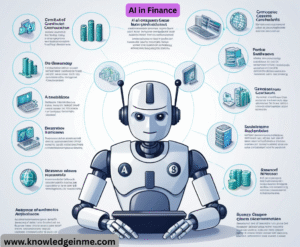
AI in Finance Of course. Here is a comprehensive overview of AI in Finance, covering its applications, key technologies, benefits, and challenges.
Executive Summary
- Artificial Intelligence (AI) is fundamentally transforming the financial services industry. By leveraging machine learning, deep learning, natural language processing, and other technologies, financial institutions are automating complex processes, generating deeper insights, managing risk more effectively, and creating hyper-personalized customer experiences. AI is no longer a futuristic concept but a core competitive advantage and operational necessity.
Key AI Technologies Used in Finance
- Machine Learning (ML) & Deep Learning: The backbone of most AI finance applications. ML models learn from historical data to identify patterns, make predictions, and classify data without being explicitly programmed for every rule.
- Deep Learning: A subset of ML using complex neural networks, ideal for unstructured data like images (e.g., check deposits) and complex pattern recognition (e.g., high-frequency trading).
- Applications: Analyzing news articles, social media, and earnings reports for sentiment (sentiment analysis), processing customer queries via chatbots, and automating document review for compliance.
- Robotic Process Automation (RPA): Uses “software robots” to automate repetitive, rule-based tasks.
- Applications: Data entry, claims processing, customer onboarding, and compliance reporting.
- Computer Vision: Enables computers to derive information from images and videos.
- Applications: Mobile check deposits, identity verification (KYC), and analyzing satellite images for economic indicators (e.g., counting cars in parking lots to predict retail sales).
Major Applications of AI in Finance
Algorithmic Trading & Investment
- High-Frequency Trading (HFT): AI algorithms execute trades in milliseconds based on market data patterns that are invisible to humans.
- Quantitative Trading: ML models analyze vast datasets (market data, economic indicators, news) to identify profitable trading opportunities and predict price movements.
Portfolio Management:
- Robo-Advisors: Automated platforms that provide and manage investment portfolios for individuals based on their risk tolerance and goals.
- AI-Powered Hedge Funds: Use sophisticated AI to develop complex, adaptive trading strategies.
Risk Management & Fraud Detection
- Credit Scoring: ML models analyze alternative data (e.g., transaction history, utility payments, social footprint) to assess the creditworthiness of individuals with little or no credit history.
- Fraud Prevention: AI systems analyze real-time transaction data to detect anomalous patterns indicative of fraud (e.g., unusual purchase location or amount), blocking transactions before they are completed.
- Anti-Money Laundering (AML): AI dramatically improves the efficiency of AML compliance by scanning millions of transactions to identify suspicious activities, reducing false positives and the manual workload for investigators.
Banking & Customer Service
- Chatbots & Virtual Assistants: Provide 24/7 customer support, answer FAQs, help with transactions, and offer financial advice (e.g., Bank of America’s Erica).
- Personalized Banking: AI analyzes a customer’s spending habits to offer personalized budgeting advice, savings goals, and product recommendations.
- Process Automation: Automating loan application processing, account opening, and insurance claims, leading to faster turnaround times and lower operational costs.
Insurance (InsurTech)
- Claims Processing: AI and computer vision can automatically assess damage from photos (e.g., car accidents, property damage), accelerating claims settlement.
- Dynamic Pricing: AI models more accurately price insurance premiums by analyzing a wider range of risk factors from telematics, IoT devices, and personal data.
- Underwriting: Automating and enhancing the risk assessment process for new insurance policies.
Regulatory Compliance (RegTech)
- Automated Compliance: AI systems can continuously monitor transactions and communications to ensure they comply with ever-changing financial regulations.
- Stress Testing: Banks use AI to simulate various economic scenarios and assess the resilience of their portfolios.
Benefits of AI in Finance
- Efficiency & Cost Reduction: Automates manual, back-office tasks, freeing up human employees for higher-value work.
- Enhanced Accuracy: Reduces human error in data processing and analysis.
- Improved Customer Experience: Provides 24/7 support, personalized products, and faster service.
- Better Risk Assessment: Enables more nuanced and predictive models for credit, fraud, and market risk.
- Data-Driven Insights: Uncovers hidden patterns in vast amounts of data, leading to better investment and business decisions.
Challenges and Risks
- Data Privacy & Security: Financial data is highly sensitive. Collecting and processing it with AI raises significant privacy concerns and makes institutions a prime target for cyberattacks.
- Bias & Fairness: If historical data used to train AI models is biased, the models will perpetuate and even amplify that bias (e.g., discriminatory lending).
- “Black Box” Problem: Some complex AI models (especially deep learning) are opaque, making it difficult to understand why they made a specific decision. This is a major hurdle for regulators and auditors.
- High Implementation Cost & Talent Gap: Developing and deploying robust AI systems requires significant investment and a scarce pool of skilled data scientists and AI engineers.
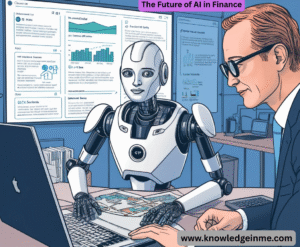
The Future of AI in Finance
- Generative AI: Models like GPT-4 are being used to draft investment research reports, create sophisticated financial models, enhance customer service chatbots, and summarize complex regulatory documents.
- Federated Learning: Training AI models across decentralized devices (e.g., on users’ phones) without sharing raw data, thus enhancing privacy.
- Hyper-Personalization: AI will move beyond product recommendations to offer fully tailored financial plans and real-time, context-aware advice.
- Advanced Sentiment Analysis: Integrating more nuanced emotional and sentiment data from news and social media into trading and risk models.
Level 2: Advanced Concepts & The Cutting Edge
The Evolution of Algorithmic Trading
- Reinforcement Learning (RL): This is the next frontier. Instead of just predicting prices, RL agents learn to trade by interacting with a simulated market environment. They are rewarded for profitable trades and penalized for losses, learning complex, multi-step strategies that can adapt to changing market regimes. Think of it as training a superhuman portfolio manager in a financial “flight simulator.”
- Alternative Data Analysis: The edge is no longer just in faster execution or better models on traditional data. It’s in the data itself. AI systems are now trained on:
- Satellite Imagery: Counting cars in retail parking lots, monitoring oil tank storage levels, or assessing crop health for commodity trading.
- Geolocation Data: Tracking foot traffic to retail stores or construction sites.
- Social Media & News Sentiment: Going beyond simple positive/negative sentiment to gauge market fear, greed, and attention to specific topics in real-time.
- Corporate Earnings Calls: Using NLP to analyze the tone, nuance, and even the vocal stress of CEOs to predict stock performance.

The Architecture of Modern Fraud Detection
- It’s not just one model; it’s a complex, layered defense system:
- Supervised Learning: Trained on millions of labeled transactions (fraudulent vs. legitimate) to recognize known patterns.
- Unsupervised Learning: Detects anomalies and novel fraud schemes by identifying transactions that deviate significantly from a user’s or a peer group’s normal behavior. This catches “zero-day” fraud.
- Graph Analytics: This is a game-changer. Instead of just looking at transactions in isolation, graph analysis maps the relationships between entities (users, merchants, IP addresses, devices). It can uncover sophisticated, coordinated fraud rings that would be invisible when looking at single data points.
- Example: A fraud ring might use 100 different credit cards from 100 different names, but if they all transact from the same IP address block and device cluster, a graph will instantly reveal the connection.
The “Black Box” Problem and Explainable AI (XAI)
This is one of the most critical challenges, especially for regulators.
- The Problem: A bank’s deep learning model denies a loan application. Why? The model can’t provide a clear reason like “debt-to-income ratio was too high.” This is unacceptable for regulatory compliance (like the “right to explanation” in GDPR) and for managing model risk.