
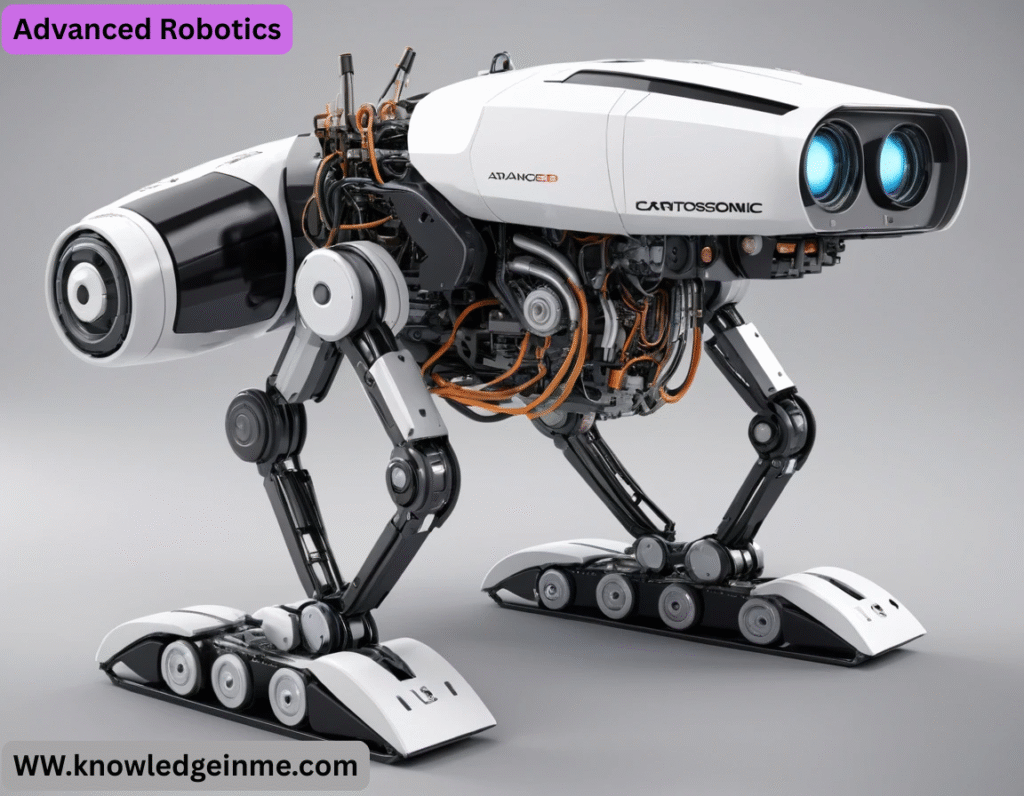

Advanced Robotics refers to the cutting-edge development and application of robotic systems that integrate sophisticated technologies such as artificial intelligence (AI), machine learning, computer vision, advanced sensors, and mechatronics. These robots are capable of performing complex tasks autonomously or semi-autonomously in dynamic environments, often surpassing traditional industrial robots in flexibility, adaptability, and intelligence.
Key Areas of Advanced Robotics
Autonomous Robots
- Self-driving vehicles (Tesla, WAYMO)
- Drones (delivery, surveillance, agriculture)
- Underwater and space exploration robots (NASA’s Mars rovers, Ocean One)
Humanoid and Social Robots
- Boston Dynamics‘ Atlas (dynamic movement, parkour)
- SoftBank’s Pepper (human-robot interaction)
- Tesla Optimus (general-purpose humanoid robot)
Medical and Surgical Robotics
- Da Vinci Surgical System (minimally invasive surgery)
- Prosthetics & Exoskeletons (bionic limbs, rehabilitation robots)
AI & Machine Learning in Robotics
- Reinforcement learning for adaptive control
- Neural networks for object recognition & decision-making
- Natural language processing (NLP) for human-robot communication
Soft Robotics & Bio-Inspired Robots
- Flexible, compliant robots mimicking octopus arms or muscle movements
- Swarm robotics (coordinated behavior in robot groups, like ants or bees)
- Industrial & Collaborative Robots (COBOTS)
- ABB YUMI, Universal Robots UR10 – work alongside humans safely
- Smart factories with IoT-connected robotic systems
Emerging Trends
- Quantum Robotics (potential for ultra-fast decision-making)
- Self-repairing & Self-replicating robots (future of space and deep-sea missions)
Challenges
- Ethics & Safety (autonomous weapons, job displacement)
- Human-Robot Trust (explainable AI, transparency)
- Energy Efficiency & Battery Life (for untethered operation)
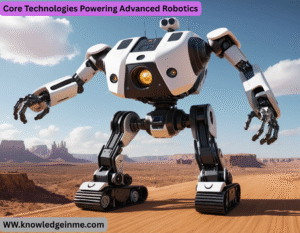
Core Technologies Powering Advanced Robotics
Artificial Intelligence & Machine Learning
- Computer Vision – Enables robots to recognize objects, faces, and environments (e.g., Tesla’s FSD, warehouse picking robots).
- Reinforcement Learning (RL) – Robots learn through trial and error (e.g., Open AI’s robotic hand solving Rubik’s Cube).
Advanced Sensing & Perception
- LiDAR & 3D Vision – For precise navigation (autonomous cars, drones).
- Tactile & Force Sensors – Allow delicate object manipulation (surgical robots, soft grippers).
- Neuromorphic Sensors – Mimic human sensory processing for low-power, high-speed decision-making.
Actuation & Mobility
- Electric vs. Hydraulic Actuators – Boston Dynamics uses hydraulics for high power, while Tesla Optimus relies on electric motors.
- Legged Locomotion – MIT’s Cheetah robot, ANY mal for rough terrains.
- Swarm Robotics – Decentralized coordination (e.g., drone light shows, search & rescue).
Edge Computing & Robotics
- Onboard AI Processing – Reduces latency (e.g., autonomous drones making real-time decisions).
- 5G & Cloud Robotics – Enables remote control and fleet learning (Amazon’s Astro, cloud-based robot training).
Cutting Edge Applications
Space & Deep-Sea Exploration
- NASA’s Valkyrie – Humanoid robot for Mars missions.
- Ocean One (Stanford) – AI-powered underwater robot with haptic feedback for deep-sea archaeology.
Healthcare & Rehabilitation
- Surgical Robots (Da Vinci, Verb Surgical) – AI-assisted precision surgery.
- Exoskeletons (EKSO Bionics, Cyberdyne HAL) – Help paralyzed patients walk again.
- Nanobots – Experimental robots for targeted drug delivery (future of medicine).
Disaster Response & Security
- Boston Dynamics’ Spot – Used in nuclear inspections and hazardous environments.
- Search & Rescue Drones – Equipped with thermal imaging for finding survivors.
Agriculture & Food Tech
- Autonomous Harvesting Robots (AGROBOT, Tortuga) – AI identifies ripe fruits and picks them.
- Vertical Farming Robots (Iron Ox, Plenty) – Fully automated indoor farms.
Future Trends & Challenges
Next-Gen Humanoid Robots
- Tesla Optimus – Aims for mass-produced, affordable humanoids for labor.
- Figure AI & 1X Robotics – Competing in general-purpose humanoids.
- Disney’s Animatronics – Hyper-realistic AI-driven characters for entertainment.
Self Learning & Meta-Robotics
- Robots that train other robots (Google’s RT-2, Open AI’s robotics models).
- Large Behavior Models (LBMs) – General AI models for diverse robotic tasks.
Ethical & Societal Challenges
- Job Displacement – Will robots replace human workers? (Debate on UBI – Universal Basic Income).
- Autonomous Weapons – UN discussing bans on “killer robots.”
- AI Bias & Safety – Ensuring robots make fair, explainable decisions.
Energy & Sustainability
- Solid-State Batteries – Longer-lasting power for untethered robots.
- Self-Charging Robots – Solar-powered or wireless charging (Boston Dynamics’ Stretch).
The Rise of Cognitive Robotics AI + Robotics Fusion
How AI is Making Robots “Think”
- Large Language Models (LLMs) in Robotics
- Google’s RT-2 enables robots to interpret abstract instructions (e.g., “move the banana to the winner”).
World Models & Simulation Based Learning
- NVIDIA’s Isaac Sim trains robots in photorealistic virtual worlds before real-world deployment.
- Meta’s Habitat 3.0 simulates human-robot interactions for social AI training.
Autonomy Beyond Pre-Programming
Self-Supervised Learning
- Boston Dynamics’ Atlas now uses AI to adapt to unknown obstacles in real time.
NEUROSYMBOLIC AI
Combining neural networks with symbolic reasoning for explainable robot decisions (critical for healthcare and law).
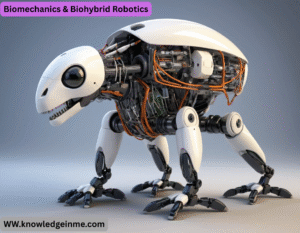
Biomechanics & Biohybrid Robotics
Robots Inspired by Nature
- Soft Robotics
- MIT’s artificial muscle (fibers stronger than human muscle).
Biohybrid Systems
- University of Tokyo’s “Living Robots” – Muscle tissue grown on robotic skeletons.
- Cyborg Insects – DARPA’s drone beetles with implanted neural controls.
- Humanoid Robotics: Beyond Imitation
- Tesla Optimus vs. Boston Dynamics Atlas
- Optimus focuses on low-cost, mass-produced utility (target: $20k per unit).
- Atlas prioritizes extreme agility (parkour, backflips) for unstructured environments.
Swarm Robotics & Collective Intelligence
When Thousands of Robots Work as One
Military Applications
- DARPA’s OFFensive Swarm-Enabled Tactics (OFFSET) – 250 drones coordinating urban missions.
- US Navy’s SEA Swarm – Autonomous boats for maritime defense.
Disaster Relief
- Harvard’s Kilo bots – Simple robots self-organizing to map disaster zones.
- Fleet of AI Drones – Used after earthquakes to locate survivors faster than humans.
Ant Inspired Manufacturing
- SWARM Project (EU) – Mini-factories where robot swarms assemble products on demand.
The Quantum Leap: Quantum Robotics
How Quantum Computing Will Revolutionize Robotics
Ultra-Fast Optimization
- Quantum algorithms solving pathfinding problems millions of times faster (e.g., delivery drone routing).
- Unbreakable Robot Communication
- Quantum encryption for secure military and industrial robots.
Brain-Level Processing
- Quantum neural networks enabling real-time human-like cognition in robots.
- (Note: Still in early research—IBM, Google, and NASA are leading.)
Ethical & Existential Challenges
The Dark Side of Advanced Robotics
Autonomous Weapons
- UN’s ongoing debate: Should “killer robots” be banned globally?
- AI-powered drone swarms already tested in conflicts (e.g., Libya, Ukraine).
Economic Disruption
- McKinsey predicts 800M jobs displaced by 2030—how will societies adapt?
Robot Rights?
If robots gain self-awareness, should they have legal rights? (Saudi Arabia granted citizenship to robot Sophia in 2017.)
Self Replicating Robots: The Dawn of Robotic Life
Von Neumann Machines & The Future of Space Colonization
- NASA’s AUTONOMY Project – Prototypes for robots that can 3D-print copies of themselves using lunar/martian regolith.
- MIT’s Robot “DNA” – Modular robots that self-assemble into different machines (like LEGO, but autonomous).
- Ethical Dilemma: If a robot can replicate, does it have a “right” to exist?
Living Robots XENOBOTS
- Tiny bioengineered “robots” made from frog stem cells (University of Vermont).
- Can self-heal, swarm, and even “reproduce” by gathering loose cells.
- Potential uses: Ocean microplastic cleanup, targeted drug delivery.
Brain Computer Interface BCI Robotics
When Your Mind Controls Machines Directly
- NEURA link (Elon Musk) – First human trials allow paralyzed patients to control robots with thoughts.
- DARPA’s Next-Gen BCI – Soldiers controlling drone swarms telepathically by 2030.
- AI-to-Brain Uploads – Could we “download” skills into our brains like in The Matrix? (Early experiments in rats.)