
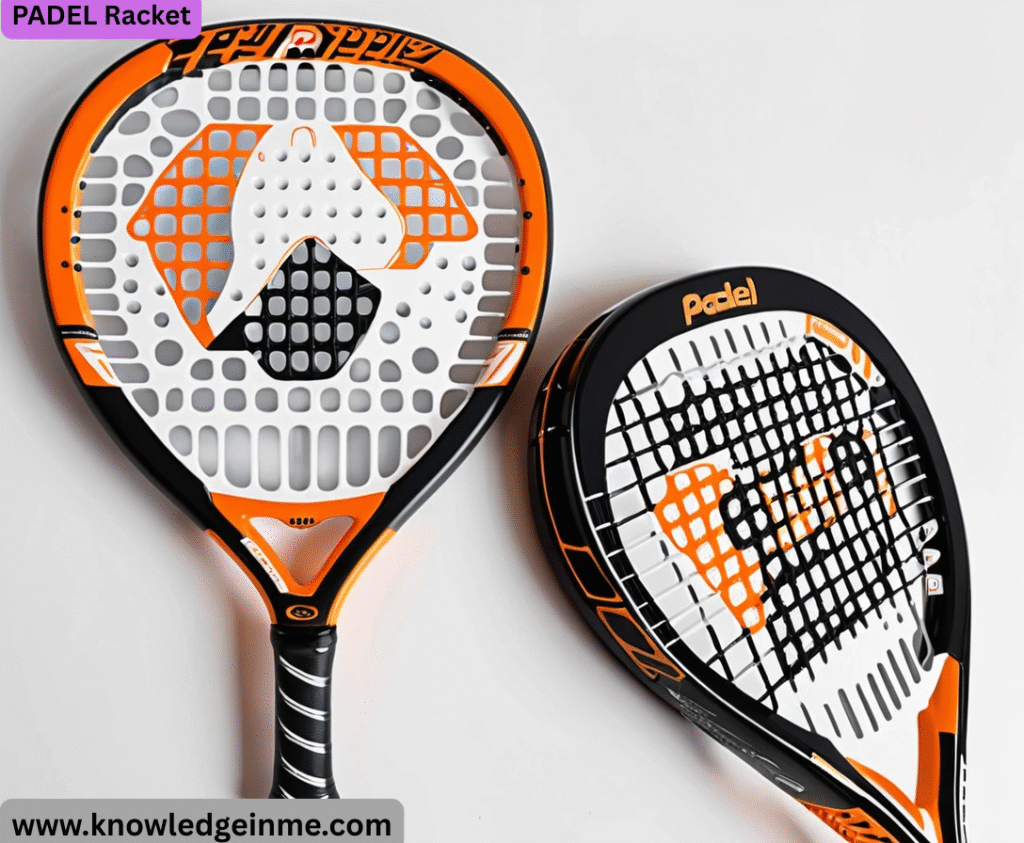

PADEL Racket Of course! Here is a comprehensive guide to padel rackets, covering everything from the basics to how to choose the perfect one for your game.
What is a Padel Racket?
- Unlike traditional tennis racquets, a padel racket is a solid, perforated paddle. It has no strings. It’s typically made from a composite frame (like carbon fiber or fiberglass) filled with a core material (usually EVA foam or rubber) and is connected to your wrist by a safety cord to prevent accidents.
Key Parts of a Padel Racket
- Understanding the components is crucial to making a good choice.
Face: The hitting surface.
- Carbon Fiber: Offers the best control, power, and durability. Stiff and responsive. (High-end rackets).
- Fiberglass: More flexible, offering more “effect” (spin) and a larger sweet spot. More forgiving. (Beginner to intermediate).
- Toughened Glass (Fibron): A middle ground, offering a blend of control and power.
- Core: The internal material that affects the racket’s feel and power.
- EVA Foam (Ethylene-Vinyl Acetate): The most common core. Comes in different densities:
- Soft EVA: More comfort, control, and less vibration. Better for arm injuries.
- Hard EVA: More power and a harder, more direct feel.
- Rubber (Goma): Less common, provides excellent control and dampening but less power.
- Shape: This dramatically influences the racket’s behavior.
- Round: Balanced weight, larger sweet spot. Excellent for control and defense. Ideal for beginners.
- Teardrop: Hybrid shape. Balances power and control. The sweet spot is medium-high. The most versatile shape, great for intermediate players.
- Diamond: Head-heavy balance. Maximizes power and smash potential. Smaller sweet spot, requires good technique. For advanced/aggressive players.
- Balance: How the weight is distributed.
- Low Balance (Round): More maneuverable and controlled.
- Medium Balance (Teardrop): A mix of power and control.
- High Balance (Diamond): More power but less maneuverable.
How to Choose a Padel Racket: A Step-by-Step Guide
Follow this process to find your perfect match.
- Step 1: Assess Your Skill Level
Beginner:
- Focus: Control, comfort, and a large sweet spot.
- Recommendation: Round shape, Fiberglass face, Soft EVA core.
- Why? This combo is forgiving, helps you learn technique without punishing your arm, and makes it easier to get the ball back into play.
Intermediate:
- Focus: A balance of power and control (versatility).
- Recommendation: Teardrop shape, Carbon/Fiberglass mix (or full carbon if budget allows), Medium EVA core.
- Why? You have the basics and now need a racket that can both defend and attack effectively.
Advanced/Expert:
- Focus: Power, precision, and winning points.
- Recommendation: Diamond shape, Full Carbon face, Hard EVA core.
- Why? You have the technique to consistently hit the sweet spot and want maximum power for smashes (bandejas and viboras) and sharp angles.
Step 2: Consider Your Playing Style
- Control Player: You prefer consistency, lobs, and playing at the net with precision. -> Round or low-balance Teardrop.
- Power Player: You look to finish points with smashes and aggressive shots. -> Diamond shape.
- Versatile/All-round Player: You adapt your game to the situation. -> Teardrop is your best friend.
Step 3: Mind Your Physical Condition
- If you have shoulder, elbow, or wrist problems (tennis elbow), avoid heavy, head-heavy rackets with a hard core.
- Opt for a round, lighter racket with a soft EVA core and fiberglass face to absorb more vibration.
Step 4: Set a Budget
- Entry-Level (€50 – €100): Mostly fiberglass, great for beginners.
- Mid-Range (€100 – €200): The best value. Carbon/fiberglass mixes and some full-carbon models. Perfect for intermediates.
- High-End (€200+): Full carbon, advanced materials, used by professionals.
Top Padel Racket Brands to Know
- Bullpadel: One of the most popular and innovative brands. (Used by Juan Lebrón).
- Adidas: Known for high-quality, well-balanced rackets across all levels.
- Head: A giant in racquet sports, offers excellent and reliable padel rackets.
- Nox: Famous for their control-oriented rackets, especially the ML10, used by many pros (like Agustín Tapia).
- Siux: Innovative and aggressive designs, often favored by power players.
- Wilson: Another racquet sports leader with a strong padel line.
- DropShot / Kuikma: Offer fantastic value for money, especially for beginners and intermediates.
Final Checklist Before You Buy
- Skill Level: Beginner, Intermediate, Advanced?
- Shape: Round, Teardrop, or Diamond?
- Material: Carbon Fiber for control/power, Fiberglass for effect/forgiveness?
- Core: Soft, Medium, or Hard EVA?
- Weight: Typically between 355-375 grams. Does it feel comfortable in your hand?
- Balance: Does it feel head-heavy or evenly balanced when you hold it?
- Grip Size: Make sure you can comfortably hold it. You can always add an overgrip to make it thicker.

Advanced Technical Deep Dive
- Core Materials: Beyond the Basics
EVA Foam (The Industry Standard):
- Soft EVA (Low Density): Pressure below 30 psi. Softer, more deformation on impact. This creates a “catapult effect,” absorbing the ball’s energy and then releasing it. This provides more ball output (power) and comfort, but can feel slightly less direct. Great for players who need extra power or have arm issues.
- Hard EVA (High Density): Pressure above 40 psi. Less deformation, giving a more direct and solid feel. The ball leaves the racket faster, offering superior control and precision, but transmits more vibration. Requires better technique to generate power.
- Multi-Density / Hybrid Cores: High-end rackets often use a combination of EVA with other materials (like rubber or different foam densities) in specific zones (e.g., around the frame or in the center) to create a unique feel, dampen vibrations, or enhance the sweet spot.
Face Materials: The Blends Matter
3K Carbon Fiber vs. 12K Carbon Fiber: This refers to the weave.
- 3K: The carbon strands are woven in bundles of 3,000 filaments. This creates a finer, denser weave. It’s generally stiffer and offers better control.
- 12K: The carbon strands are woven in bundles of 12,000 filaments. This creates a broader, more visible weave. It’s often slightly more flexible, offering a better “effect” (spin) and a bit more forgiveness.
- Reality: Most high-end rackets use a mix of both in different parts of the face to optimize performance.
- Sandblasted / Rough Surfaces: Many rackets have a textured finish on the face. This increases friction between the ball and the racket, significantly enhancing your ability to generate spin (effect) for sliced shots, lobs, and bandejas.
The “Sweet Spot” Explained Technically
- The sweet spot isn’t just one spot; it’s an area with two key properties:
- Center of Percussion: Where the impact produces minimal shock to your hand.
- Node of Vibration: Where the impact produces minimal vibration.
- A round-shaped racket positions this sweet spot closer to the center of the racket, making it larger and easier to find. A diamond-shaped racket moves it higher towards the head, making it smaller but more powerful when hit perfectly.
The Racket’s Role in Specific Shots
- Bandeja / Vibora: A teardrop or diamond racket with a medium/hard feel provides the perfect blend of control for the cut and power for the finish.
- Chiquita (Low, Hard Shot): A stiff, carbon-faced racket offers the direct, responsive feel needed for this fast, precise shot.
- Defensive Lobs off the Glass: A softer, round racket gives you more time and control to lift the ball accurately from a defensive position.
- Smash (Remate): A head-heavy, diamond-shaped racket with a hard core is a cannon, providing maximum power and explosiveness.
Maintenance & Care (Extending Your Racket’s Life)
- Protectors are NON-NEGOTIABLE: Always use a racket cover. The carbon fiber and paint are susceptible to scratches and impacts against walls and the floor, which can lead to cracks.
- Temperature is Key: NEVER leave your racket in a hot car. The internal EVA core expands when heated and can delaminate (separate from the frame) or form bubbles, permanently damaging the racket.
- Clean the Surface: Use a soft brush or cloth to remove dust and sand from the holes after playing. Abrasive materials can wear down the surface.
- Check the Overgrip: A fresh, dry overgrip provides better grip and absorbs sweat, protecting the original base grip underneath. Change it regularly.