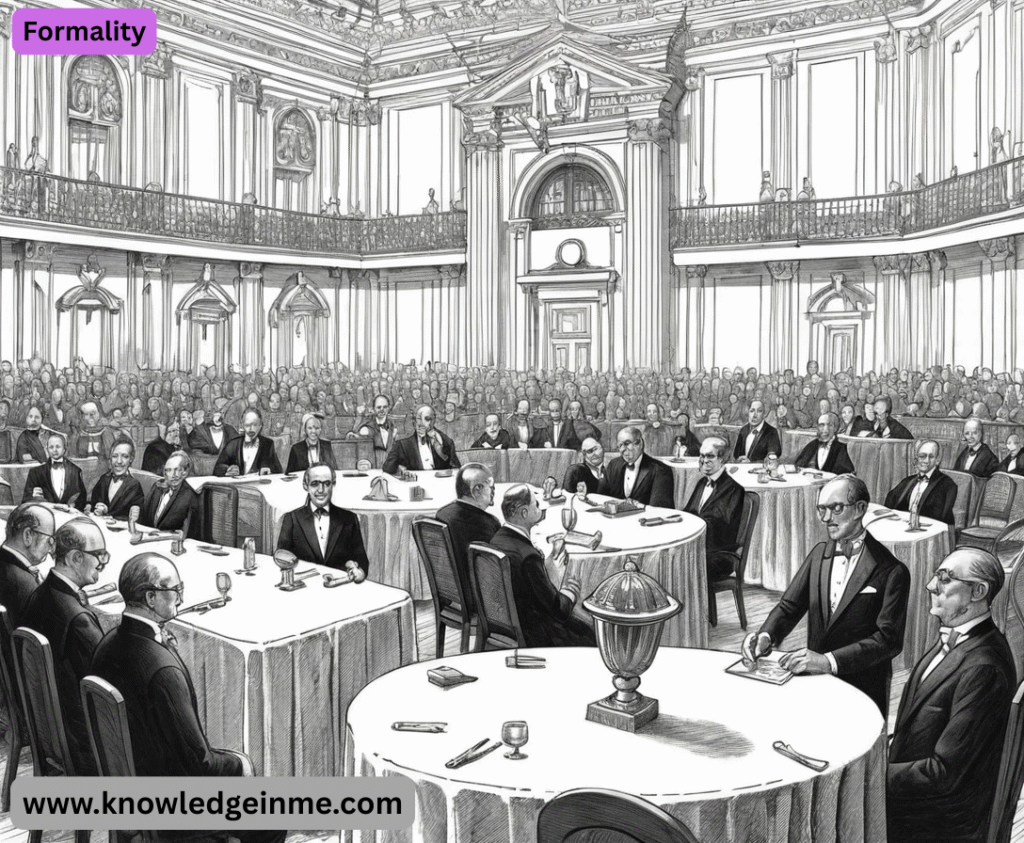

Formality Of course. “Formality” is a rich word with several nuanced meanings, depending on the context. At its core, it refers to the established structures, rules, and conventions that govern official or serious situations.
The Core Concept: Compliance with Rules and Conventions
This is the most common meaning. Formality is the strict observance of rules, etiquette, or procedure.
- In Behavior: Acting with formality means being polite, reserved, and following social codes (e.g., using titles like “Dr.” or “Your Honor,” sending a formal thank-you note).
- In Language: Formal language is precise, structured, and avoids contractions, slang, and colloquialisms. Compare “I cannot attend the meeting” (formal) with “I can’t make it” (informal).
- In Procedure: A formality is a step that must be taken to comply with a rule, often one that is routine and whose outcome is already known.
The Different Shades of Meaning
As a Required Procedure (Often a Minor One)
- When something is “a mere formality,” it means it is an official step that must be taken, but the result is a foregone conclusion.
- Example: “The final interview is just a formality; the job is yours.”
- Example: “Signing these papers is a formality to make the decision official.”
As a Characteristic of Style or Manner
This describes the quality of being formal.
- Example: “The formality of the wedding required white-tie attire.”
- Example: “He spoke with great formality, which made everyone feel a bit distant.”
As a Rigid Adherence to Convention
- Sometimes, formality has a slightly negative connotation, implying stiffness, coldness, or a lack of genuine feeling.
- Example: “The evening was plagued by an oppressive formality, and no one felt comfortable enough to laugh.”
How to Use “Formality” in a Sentence
As a Noun (Most Common):
- “The formality of the contract made it hard to read.”
- “Let’s dispense with the formalities and speak frankly.”
- “Passing the security check was a necessary formality.”
- As an Adjective: The word is “formal.” “Formality” itself is not used as an adjective.
- Correct: “It was a formal dinner.”
- Incorrect: “It was a formality dinner.”
The “Why” Behind Formality: More Than Just Rules
Formality isn’t arbitrary. It serves several crucial functions in society and organizations:
- Social Lubricant: Formal rules of etiquette prevent friction. They provide a pre-scripted way to interact, reducing uncertainty and potential offense, especially between strangers or in hierarchical settings.
- Efficiency and Predictability: In legal, diplomatic, and business contexts, formal procedures ensure that everyone follows the same process. This creates predictability, reduces errors, and allows for fair and consistent outcomes. A court trial must be formal to ensure justice.
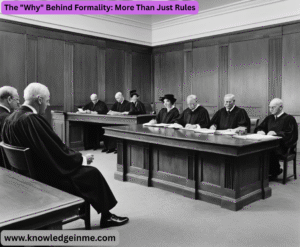
- Establishing Authority and Legitimacy: Formality creates distance and reinforces hierarchy. The robes of a judge, the uniform of a general, or the specific language of a legal document all serve to legitimize authority and separate the office from the individual.
- Marking Significance: We use formality to signal that an event is important and distinct from everyday life. Weddings, graduations, and state funerals are highly formal to mark their cultural and personal significance.
- Promoting Precision: Formal language, especially in technical, legal, and academic writing, aims to eliminate ambiguity. It prioritizes clarity and specific meaning over flair and emotional expression.
Key Linguistic Markers of Formality:
- Vocabulary: Latinate words vs. Germanic words (e.g., “commence” vs. “start”; “inquire” vs. “ask”).
- Contractions: Avoiding them (“do not” is more formal than “don’t”).
- Pronouns: Using “one” instead of “you” (e.g., “One must consider the consequences”).
- Voice: Preferring the passive voice in scientific writing to sound objective (e.g., “The experiment was conducted” instead of “We conducted the experiment”).
Social and Cultural Norms
Formality is culturally relative. What is considered polite and formal in one culture can be seen as cold or even rude in another.
- Japan: A high-context culture with strict formal rules (keigo honorific language) for language, bowing, and exchanging business cards (meishi).
- Scandinavia: Generally less formal, with a flatter social hierarchy. Using first names quickly is the norm, even with CEOs.
- The Middle East: Building personal relationships is crucial in business, often involving elaborate and formal hospitality rituals before getting down to business.
Law and Governance
This is where formality is arguably most critical. The Rule of Law depends on formal procedures.
- Due Process: The formal legal process that the state must follow is designed to protect the rights of individuals.
- Legislation: Laws are written in a formal, precise style to minimize misinterpretation.
- International Diplomacy: Protocol, treaties, and diplomatic language are highly formalized to maintain order and respect between nations.
The Double-Edged Sword: Criticisms of Formality
Formality is not without its drawbacks:
- Inefficiency: “Red tape” is a pejorative term for excessive formality and bureaucracy that hinders action and progress.
- Barrier to Authenticity: It can stifle genuine human connection, creativity, and honest feedback. People may feel they cannot be their “true selves.”
- Elitism and Exclusion: Mastery of formal codes (e.g., which fork to use, specific vocabulary) can be a marker of social class, creating barriers for those not raised with those norms.
- Rigidity: An over-reliance on formality can prevent an organization or system from adapting quickly to change.
Navigating Formality: A Practical Skill
Knowing how to navigate formality is a key aspect of emotional and cultural intelligence.
- Read the Room: Observe how others are dressing, speaking, and behaving. When in doubt, it’s usually safer to start more formally and then relax as the situation allows.
- Context is King: A startup brainstorming session demands a different level of formality than a board meeting at a multinational corporation.
- The Power of “Code-Switching”: The ability to consciously shift your style of speech and behavior between formal and informal contexts is a valuable professional and social asset.
- Intent Matters: The purpose of formality is ultimately to show respect and facilitate clear communication. If it’s achieving the opposite, it may be time to consciously break from it.
Formality as a System of Abstraction
- At its most abstract, formality is the process of separating the essential from the contingent. It’s about creating a system that is independent of the specific individuals or momentary contexts involved.
- The Game of Chess: The rules of chess are perfectly formal. They are abstract, applying equally to anyone who plays, regardless of who they are, their mood, or the physical beauty of the chess set. The move of a “knight” is defined by its L-shaped path, not by the piece’s carved horse head. This abstraction is what makes the game fair, repeatable, and a subject of deep study.
- Computer Programming: Code is the epitome of formality. It is a set of strict, unambiguous rules and syntax that a machine follows exactly. There is no room for informal interpretation. A missing semicolon breaks the entire formal structure.
- This shows that formality is not just about politeness; it’s about creating a self-contained system of rules that can be analyzed and executed independently.

The Psychology of Formality: The “Mask” and the “Ritual”
Formality has a profound psychological impact on both the individual and the group.
- The Mask of Office: When a judge puts on a robe, they are donning a “mask.” This ritual transforms the individual into the embodiment of the law. This serves two purposes:
- For the Individual: It allows them to perform a role that may require more authority or impartiality than they feel as a private person.
- For the Group: It reassures us that we are interacting with the institution, not the flawed human. The builds trust in the system.
- Ritual and Shared Experience: The formal rituals of a religious service, a graduation, or even a team’s pre-game huddle create communitas—a sense of shared identity and purpose. The repetitive, formal actions synchronize the group and elevate the experience above the mundane.
- Cognitive Load Reduction: Informality requires constant, subtle negotiation. provides a pre-set script. You don’t have to decide how to address the Queen; the formal protocol is already established, freeing your mental energy for the content of the interaction.