

Parts of the Cell Of course! Here is a comprehensive breakdown of the major parts of a cell, organized for clarity. They come in two main types: Prokaryotic (simple, like bacteria) and Eukaryotic (complex, found in plants, animals, fungi, and protists). This guide focuses on the organelles (internal structures) of a Eukaryotic Cell, noting key differences between animal and plant cells.
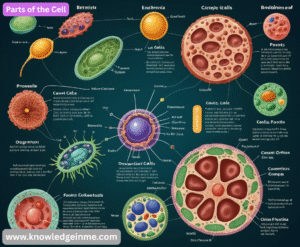
The Major Cell Parts and Their Functions
The Command Center: The Nucleus
- Function: The control center of the cell. It contains the cell’s genetic material (DNA) and directs all cellular activities like growth, metabolism, and reproduction by regulating gene expression.
Key Parts:
- Nuclear Envelope: A double membrane that surrounds and protects the nucleus.
- Nuclear Pores: Tiny channels in the nuclear envelope that allow materials (like RNA and proteins) to move in and out.
- Nucleolus: A dense region inside the nucleus where ribosome assembly begins.
- Analogy: The CEO’s office or the brain of the cell.
The Power Plants: Mitochondria (Singular: Mitochondrion)
- Function: Often called the “powerhouses of the cell.” They perform cellular respiration, a process that converts energy from food into adenosine triphosphate (ATP), the energy currency of the cell.
- Unique Feature: They have their own small amount of DNA.
- Analogy: The power plant or battery of the cell.
The Protein Factories: Ribosomes
- Function: The sites of protein synthesis. They read genetic instructions from the nucleus and assemble amino acids into proteins.
- Location: Found floating freely in the cytoplasm or attached to the endoplasmic reticulum.
- Analogy: The assembly line workers or 3D printers of the cell.
The Transportation Network: Endoplasmic Reticulum (ER)
This is a network of membranes connected to the nuclear envelope. It comes in two forms:
Rough Endoplasmic Reticulum (RER):
- Identified by: Ribosomes attached to its surface.
- Function: Synthesizes, folds, and modifies proteins made by the ribosomes. It’s a “protein factory assembly line.”
Smooth Endoplasmic Reticulum (SER):
- Identified by: No ribosomes on its surface.
- Function: Synthesizes lipids (fats), detoxifies poisons (especially in liver cells), and stores calcium ions.
- Analogy: The manufacturing and packaging department.
The Post Office: Golgi Apparatus (or Golgi Body)
- Function: Receives, modifies, sorts, tags, and packages proteins and lipids from the ER into vesicles for shipment to their final destinations—either within the cell or outside of it.
- Analogy: The post office or Amazon fulfillment center of the cell.
The Storage Units: Vacuoles
- Function: Large, membrane-bound sacs used for storage. They store water, ions, nutrients, and waste products.
- Plant vs. Animal Cells: Plant cells have a single, large central vacuole that also provides structural support (turgor pressure). Animal cells have smaller, more numerous vacuoles.
- Analogy: The warehouse or storage closets of the cell.
The Recycling Center: Lysosomes
- Function: Contain powerful digestive enzymes to break down (digest) worn-out organelles, food particles, engulfed viruses or bacteria, and waste. They are the cell’s waste disposal and recycling system.
- Primarily in: Animal cells. (In plants, similar functions are performed by the vacuole).
- Analogy: The stomach or recycling center of the cell.
The Framework: Cytoskeleton
- Function: A network of protein filaments that provides structural support, enables cell movement (e.g., muscle contraction), and acts as a “highway” system for transporting vesicles within the cell.
- Main Components: Microfilaments (actin), intermediate filaments, and microtubules.
- Analogy: The skeleton and muscles of the cell.
The “Jelly”: Cytoplasm (Cytosol)
- Function: The gel-like fluid that fills the cell interior. It contains all the organelles and is where many cellular processes and reactions (like glycolysis) occur.
- Analogy: The air filling a factory building.
The Outer Boundary: Cell Membrane (Plasma Membrane)
- Function: A semi-permeable barrier that surrounds the cell. It controls what enters and exits the cell, provides protection, and facilitates communication with other cells.
- Structure: Composed of a phospholipid bilayer with embedded proteins.
- Analogy: The security gate and fence of the cell.
Plant Cell-Specific Organelles
The Outer Wall: Cell Wall
- Function: A rigid layer (made of cellulose) located outside the cell membrane. It provides structural support, protection, and gives the plant cell its shape.
- Analogy: The brick wall of a factory building.
The Solar Panels: Chloroplasts
- Function: The sites of photosynthesis. They contain the green pigment chlorophyll, which captures energy from sunlight and converts it into chemical energy (sugar) for the plant.
- Unique Feature: Like mitochondria, they have their own DNA.
- Analogy: The solar panels of the cell.
The Cytoskeleton in Detail
- The cytoskeleton is not just a static skeleton; it’s a dynamic, ever-changing network crucial for many functions.
Microfilaments (Actin Filaments):
- Structure: The thinnest filaments, made of actin protein.
- Function: Responsible for cell movement (like muscle contraction via interaction with myosin) and cytokinesis (the pinching of a cell into two during division). They provide mechanical strength and help form cellular extensions like microvilli.
Intermediate Filaments:
- Structure: Ropelike fibers of various proteins (e.g., keratin).
- Function: Purely structural. They are exceptionally durable and provide tensile strength, anchoring organelles like the nucleus in place. They are not involved in movement.
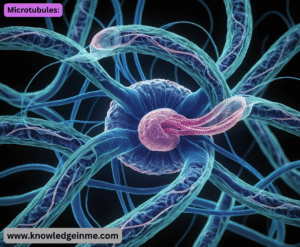
Microtubules:
- Structure: The largest component, hollow tubes made of tubulin protein.
- Function: Act as “highways” for motor proteins (kinesin and dynein) to transport vesicles, organelles, and other cargo. They form the mitotic spindle that separates chromosomes during cell division. They are also the core structural element of cilia and flagella (hair-like structures used for cell movement).
Specialized Structures for Movement
- Cilia: Short, hair-like projections that cover a cell’s surface. They beat in a coordinated, wave-like motion to move fluid or particles past the cell (e.g., moving mucus out of your trachea).
- Flagellum (Flagella): A long, whip-like projection (usually one or two per cell) used to propel the entire cell itself (e.g., the tail of a sperm cell).
The Endomembrane System
- This is a complex, integrated system of organelles that work together to modify, package, and transport lipids and proteins. It includes:
Nuclear Envelope
- Endoplasmic Reticulum (ER)
- Golgi Apparatus
- Lysosomes
- Vacuoles
- Cell Membrane
Think of it as a product’s journey from manufacturing (ER) to packaging and labeling (Golgi) to shipping to its final destination (via vesicles).
The Extracellular Matrix (ECM) – Animal Cells
- What it is: A complex network of carbohydrates and proteins (like collagen) secreted by animal cells into the space surrounding them.
- Function: Provides structural and biochemical support to surrounding cells. It is essential for cell communication (signaling), adhesion, and defining the tissue’s physical properties (e.g., the toughness of bone, the elasticity of skin).
Junctions: How Cells Connect
Cells don’t just float next to each other; they are intricately connected.
- Tight Junctions: Form a watertight seal between cells, preventing leakage. (e.g., in the digestive tract, keeping stomach acid from leaking into other tissues).
- Anchoring Junctions (Desmosomes): Act like rivets or spot welds, fastening cells together into strong sheets. Important in tissues that endure stress, like skin and heart muscle.
- Gap Junctions: Act as channels connecting the cytoplasm of adjacent cells. They allow ions and small molecules to pass directly between cells, enabling rapid communication. (e.g., in heart muscle cells to coordinate contractions).
Key Concepts in Cell Biology
- Compart mental ization: This is the key advantage of eukaryotic cells. Membrane-bound organelles allow incompatible chemical reactions to occur simultaneously in different compartments. For example, the lysosome can be breaking down debris at a low pH while the rest of the cytoplasm maintains a neutral pH.
- The Flow of Genetic Information: This is often called the “Central Dogma” of molecular biology. It describes the path from the instructions in the nucleus to the functional product:
DNA (in nucleus) → Transcription → RNA → Translation → Protein (at ribosome) - Endosymbiotic Theory: This theory explains the origin of mitochondria and chloroplasts. It proposes that they were once free-living prokaryotic organisms that were engulfed by a larger host . Instead of being digested, they formed a symbiotic (mutually beneficial) relationship. The evidence for this is strong:
- They have their own DNA (circular, like bacteria).
- They have their own ribosomes (similar to bacterial ribosomes).
- They can replicate independently of the cycle.