


Sunset Locations Of course! The “best” sunset location is highly personal and depends on what kind of experience you’re looking for. Here is a comprehensive guide to sunset locations, categorized by the type of view and experience.
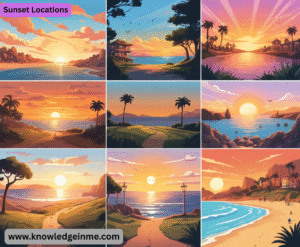
Iconic & World-Famous Sunset Spots
These are the places that consistently top “best of” lists for their breathtaking and reliable beauty.
- Sunset Locations Santorini, Greece: The quintessential sunset destination. The white-washed villages of Oia and Fira perched on the caldera cliffside offer an uninterrupted view of the sun melting into the Aegean Sea.
- Grand Canyon, USA (Arizona): The play of light and shadow on the vast canyon walls creates a spectacular, ever-changing display. Key viewpoints are Hopi Point (South Rim) and Cape Royal (North Rim).
- Uluru (Ayers Rock), Australia: Witness the monolithic sandstone rock transform through a fiery palette of reds, oranges, and purples at sunset. The designated viewing areas are perfectly positioned for this natural light show.
- Key West, Florida, USA: Home to the nightly “Sunset Celebration” at Mallory Square. It’s a festive, communal event with street performers, food vendors, and crowds applauding the sun as it dips below the Gulf of Mexico.
- Serengeti National Park, Tanzania: The combination of a blood-orange sun sinking below the vast African savanna, often silhouetting acacia trees and wildlife, is an unforgettable experience.
- Taj Mahal, Agra, India: Seeing the sun set behind this magnificent ivory-white marble mausoleum gives it a warm, golden glow. The view from across the Yamuna River at Mehtab Bagh is the classic spot.
By Landscape/Environment
Choose your preferred backdrop.
Over the Ocean/Sea:
- Any West-Coast Beach: Think Malibu, California; Waikiki Beach, Hawaii; or Pfeiffer Beach in Big Sur.
- The Maldives: Overwater bungalows provide a private, 360-degree view of the sun setting into the Indian Ocean.
- Bali, Indonesia: Beach clubs in Canggu and Jimbaran Bay (where you can have fresh seafood dinner on the sand) are famous for their sunsets.
From a Mountain Summit:
- Machu Picchu, Peru: Watching the sunset over the ancient Incan ruins and surrounding Andes mountains is a mystical experience. (Note: you must be on a guided tour to stay for sunset).
- Mount Bromo, Indonesia: A surreal landscape of volcanic sand and crater smoke makes for a dramatic, otherworldly sunset.
- Rocky Mountains, USA/Canada: Any high alpine lake or peak facing west, like Moraine Lake or Lake Louise in Banff, offers stunning reflections.
In the Desert:
- Wadi Rum, Jordan: The red sand and dramatic rock formations of “The Valley of the Moon” create an epic, Mars-like setting for sunset.
- Death Valley, USA (California): Locations like Zabriskie Point or Mesquite Flat Sand Dunes offer stark, beautiful landscapes for the setting sun.
- Sossusvlei, Namibia: The contrast of the deep red sand dunes against the darkening sky is a photographer’s dream.
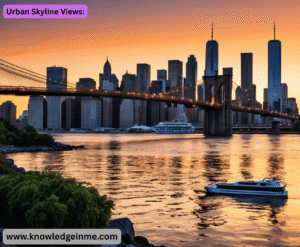
Urban Skyline Views:
- Sunset Locations Brooklyn Bridge Park, New York City: The Manhattan skyline silhouetted against a setting sun is an iconic urban panorama.
- Griffith Observatory, Los Angeles: Offers a famous view of the sun setting behind the Hollywood Hills and, as dusk falls, the sprawling city lights.
- Riverfront, Chicago: Watching the sun set behind the iconic architecture of the Chicago skyline from the lakeshore or a river cruise is spectacular.
How to Find a Great Sunset Location Near You
You don’t need to travel across the world to see a beautiful sunset. Here’s how to find one locally:
- Find a West-Facing Vista: This is the most important rule. Use an app like Google Maps to identify local parks, beaches, or hills that have an unobstructed view to the west.
- Get Elevated: Rooftop bars, hilltops, or even a high floor in a building can provide a clearer view over trees and other obstacles.
- Use the Water: Lakes, rivers, and reservoirs that face west will provide a beautiful reflective surface for the sunset colors.
- Check the Forecast: Use weather apps to check for cloud cover. A sky with 30-70% cloud cover often creates the most dramatic sunsets, as the clouds catch and scatter the light into brilliant colors. Completely clear skies can be less striking.
- Use a Sunset App: Apps like PhotoPills or The Photographer’s Ephemeris are fantastic for planners and photographers. They show you the exact path the sun will take on any given day on a map, so you can perfectly position yourself.
Pro Tips for the Best Experience:
- Arrive Early: Show up at least 30-45 minutes before the official sunset time. The changing light in the lead-up (“golden hour”) is often just as beautiful.
- Stay Late: The colors often peak 10-30 minutes after the sun has dipped below the horizon. This period is called the “afterglow” or “civil twilight.”
- Check the Time: Sunset times change throughout the year. A quick search for “sunset time [your city]” will give you the exact time to plan for.
The Science of a Spectacular Sunset: Why Some Are Better Than Others
Understanding the science helps you predict when a sunset will be truly magical.
- Sunset Locations Rayleigh Scattering: This is the fundamental process. Sunlight is made of all colors. The atmosphere scatters shorter wavelengths (blues and violets) away from your eye, leaving the longer wavelengths (reds, oranges, and pinks) to dominate what you see.
- The Role of Particles: The true secret to a mind-blowing sunset is aerosols. These are tiny particles in the air—dust, pollution, smoke, salt from the ocean, or even volcanic ash.
- These particles act as a canvas, scattering and reflecting the vibrant red and orange light even more effectively, amplifying the color.
- This is why sunsets are often more stunning after a rainstorm (the rain clears large particles but leaves aerosols) or in places with clean, dust-free air (like the tropics), but also paradoxically in polluted cities (where particles are abundant).
- The Cloud Factor: As mentioned, a completely clear sky offers little surface for the light to “paint.” High and mid-level clouds (like altocumulus or cirrus clouds) are the best canvases. They catch the fire from the sun below the horizon and turn into brilliant, illuminated sculptures.
The Sunset Hunter’s Checklist: How to Plan Your Mission
Forecast, Don’t Guess:
- Weather Apps: Don’t just look for “sunny.” Look for “mostly sunny” or “partly cloudy.” Apps like MyRadar show cloud layers at different altitudes.
- Dedicated Sky Apps: SkyView or Sun Surveyor (more advanced) use your camera to show the exact path of the sun through the sky on any given day. This is invaluable for planning a shot or knowing if a building will block the view.
The Golden Hour & Blue Hour:
- Golden Hour: The hour just after sunrise and just before sunset. The light is soft, warm, and directional, perfect for photography and creating a magical glow. This is your main event.
- Blue Hour: The period of twilight just before sunrise and just after sunset when the sun is far below the horizon, but its indirect light casts a deep blue hue across the world. City lights start to pop, creating beautiful scenes. Don’t leave as soon as the sun disappears!
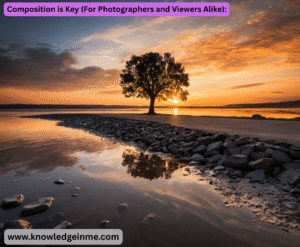
Composition is Key (For Photographers and Viewers Alike):
A sunset is beautiful on its own, but a great sunset view has a compelling foreground. Look for:
- Silhouettes: A lone tree, a pier, a person, a famous monument.
- Reflections: Water, glass buildings, wet sand, a car windshield.
- Leading Lines: A path, a road, a river that guides the eye into the sunset.
- Texture: Rocks, waves, or fields that add depth to the scene.
Unique & Underrated Sunset Experiences
- Sunset Locations From a Moving Vehicle: The sunset viewed from a train crossing a prairie or a ship in the middle of the ocean offers a unique, unobstructed, and transient perspective.
- In a Forest Clearing (“Green Hour”): While you won’t see the sun itself, the way the last golden rays filter through the trees, creating long shadows and a warm, dappled light, is a special kind of sunset experience.
- During a Meteor Shower or Lunar Event: Pairing a sunset with another celestial event (e.g., a crescent moon setting just after the sun) can create a once-in-a-lifetime view.
- In Total Silence: We often watch sunsets socially. Try experiencing one completely alone and in silence. The feeling of the day ending and the world settling is profoundly peaceful.