


Entrepreneurship At its core, entrepreneurship is the process of designing, launching, and running a new business, which typically starts as a small business, such as a startup, offering a product, process, or service for sale or hire.

An entrepreneur is an individual who:
- Bears most of the risks (financial, professional, personal).
- Enjoys most of the rewards (profit, freedom, impact).
- Is characterized by innovation, initiative, and a drive for change.
- Entrepreneurship is not just about starting any business; it’s about identifying a problem or a need and building a scalable and innovative solution around it.
The Entrepreneurial Process
The journey of an entrepreneur typically follows a cyclical process:
- Idea Generation & Identification: Spotting a market gap, a customer pain point, or a new application for technology.
- Market Research & Validation: Testing the idea to see if there is a real demand for it. This involves talking to potential customers, analyzing competitors, and assessing the market size.
- Planning: Creating a business plan. It’s a roadmap for the venture.
- Acquiring Resources: Securing the necessary capital (funding through bootstrapping, loans, investors), building a team, and establishing a legal structure (LLC, Corporation, etc.).
- Launch & Execution: Bringing the product or service to the market and starting operations.
- Growth & Scaling: Managing the business for growth, which may involve entering new markets, expanding the product line, or acquiring more customers.
- Adaptation & Pivoting: Continuously gathering feedback and being willing to change the business model or product based on what the market responds to.
Key Characteristics of Successful Entrepreneurs
While there’s no single “entrepreneur personality,” successful founders often share these traits:
- Passion & Persistence: A deep belief in their idea and the tenacity to overcome inevitable obstacles and failures.
- Risk-Tolerance: The ability to make decisions and take calculated risks in the face of uncertainty.
- Resilience: The capacity to recover quickly from setbacks, rejections, and failures.
- Adaptability: Being flexible and willing to pivot when initial plans don’t work.
- Vision & Leadership: The ability to see the big picture and inspire a team to work towards that vision.
- Resourcefulness: The skill of making do with what you have and finding clever ways to overcome limitations (often called the “juggling act”).
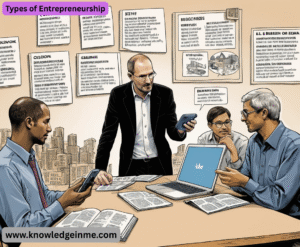
Types of Entrepreneurship
Entrepreneurship is a diverse field with several distinct paths:
- Small Business Entrepreneurship: The most common type. This includes local shops, restaurants, consultants, and freelancers. The primary goal is to generate income to support a family, not necessarily to disrupt an industry or scale massively.
- Scalable Startup Entrepreneurship: These begin with a vision to change the world. They are often tech-focused, seek venture capital funding, and aim for rapid growth and a large market share (e.g., Facebook, Uber, Airbnb).
- Social Entrepreneurship: Focuses on creating businesses to solve social or environmental problems. Profit is a means to sustain the mission, not the primary goal (e.g., TOMS Shoes, Grameen Bank).
- Innovative Entrepreneurship: Centered around a groundbreaking new product or service that creates a new market (e.g., Steve Jobs with the iPhone).
- Intrapreneurship: The act of behaving like an entrepreneur while working within a large, established organization.
Why is Entrepreneurship Important?
Entrepreneurs are vital drivers of a modern economy. They:
- Drive Innovation: Create new technologies, products, and services that improve our lives.
- Create Jobs: New businesses are the primary source of net job creation in many economies.
- Spur Economic Growth: Introduce competition, increase productivity, and contribute to the Gross Domestic Product (GDP).
- Solve Problems: Address societal and environmental challenges through innovative business models.
Common Challenges & Risks
The path of entrepreneurship is fraught with difficulty:
- Financial Risk: Personal savings are often on the line. Consistent cash flow is a major challenge.
- High Failure Rate: A significant percentage of new businesses fail within the first few years.
- Uncertainty & Stress: The burden of decision-making and the lack of a stable paycheck can be mentally taxing.
- Work-Life Balance: The business can demand an immense amount of time and energy, often at the expense of personal life.
- Finding Product-Market Fit: Creating something that people actually want to buy is harder than it seems.
Getting Started
If you’re interested in entrepreneurship:
- Find a Problem to Solve: Start with a pain point you or others experience.
- Learn relentlessly: Read books, take online courses, and listen to podcasts from founders.
- Build a Network: Connect with other entrepreneurs, mentors, and potential customers.
- Start Small: You don’t need a perfect plan or a lot of money to begin validating your idea.
- Embrace Failure: View setbacks as learning experiences, not reasons to quit.
The Business Model Canvas (BMC):
It’s a one-page document that replaces the traditional, lengthy business plan for early-stage startups. It focuses on 9 building blocks:
- Customer Segments: Who are you creating value for?
- Value Propositions: What problem are you solving? What unique value do you deliver?
- Channels: How do you reach your customers?
- Revenue Streams: How does the business make money?
- Key Activities: What strategically important things must the business do to work?
- Key Resources: What unique assets must you have (physical, intellectual, human, financial)?
- Key Partnerships: Who are your key suppliers and partners?
- Cost Structure: What are the major costs involved?
Lean Startup Methodology:
- A methodology pioneered by Eric Ries that emphasizes iterative creation to avoid building products nobody wants.
- Build-Measure-Learn: The core feedback loop. Build a Minimum Viable Product (MVP), measure how customers use it, and learn whether to pivot or persevere.
- Minimum Viable Product (MVP): The version of a new product that allows a team to collect the maximum amount of validated learning about customers with the least effort. It’s not a minimal product; it’s a strategy for learning.
Product-Market Fit:
- Coined by Marc Andreessen, this is the holy grail for startups. It means being in a good market with a product that can satisfy that market. You know you have it when customers are buying your product as fast as you can make it, usage is growing, and people are recommending it to others.

Funding Stages:
Entrepreneurs need to understand the capital landscape:
- Bootstrapping: Funding the business yourself through personal savings and early revenue.
- Pre-seed & Friends/Family: The earliest stage, often used to build an MVP.
- Seed Funding: The first official equity funding stage. Used to finance market research and product development.
- Venture Capital (Series A, B, C…): Larger rounds of funding for scaling a proven business.
- Angel Investors: Affluent individuals who provide capital for a startup, often in exchange for convertible debt or ownership equity.
The Dark Side & Common Pitfalls
The glamorous image often hides the harsh realities.
- To grow fast (and potentially become very wealthy), you usually need to give up control to investors and a board. To maintain total control, you often have to grow slower and may create a smaller, lifestyle business.
- Co-founder Conflict: Disagreements over equity, strategy, roles, and work ethic are a leading cause of startup failure. Choosing a co-founder is often compared to a marriage.
- Mental Health Struggles: The immense pressure, isolation, and constant uncertainty can lead to anxiety, depression, and burnout. The term “entrepreneurial depression” is widely recognized.
- Running Out of Cash: Poor financial management and a lack of focus on revenue (or the next funding round) is a death sentence. It’s not about profit on a spreadsheet; it’s about cash in the bank.
Modern Trends Shaping Entrepreneurship
- The Rise of the Solopreneur & Micro-SaaS: Tools like Shopify, Substack, and no-code platforms (e.g., Bubble, Webflow) allow individuals to build highly profitable, scalable businesses entirely on their own.
- Remote-First & Asynchronous Work: Startups are now built with distributed teams from day one, accessing global talent and operating across time zones.
- Community-Led Growth: Building a dedicated community around your brand or product before you even have a product, turning them into your first customers and strongest evangelists.
- Focus on ESG (Environmental, Social, Governance): Investors and consumers increasingly favor businesses that are sustainable, ethical, and socially responsible.
- The Creator Economy: Entrepreneurs are building personal brands and businesses as influencers, educators, and content creators, monetizing their expertise and audience directly.
Actionable Advice for Aspiring Entrepreneurs
- Start with “Why?”: Simon Sinek’s famous concept. Know your deeper purpose and mission. This will be your anchor during tough times.
- Fall in Love with the Problem, Not the Solution: Your initial idea will almost certainly change. Being committed to solving a problem allows you to pivot your solution without losing direction.
- Get Out of the Building: Steve Blank’s mantra. You cannot learn about customers from your desk. Go talk to them. Observe them. Understand their lives.
- Focus on a Niche: Don’t try to build something for “everyone.” Start by serving a very specific group extremely well (e.g., “yoga instructors in Austin” instead of “people who exercise”).
- Ship It: Perfectionism is the enemy of progress. Launch your MVP before you think it’s ready. The feedback you get is infinitely more valuable than your assumptions.