


Mindfulness and Meditation Of course. Here is a comprehensive overview of mindfulness and meditation, explaining what they are, their benefits, how they differ, and how to get started.
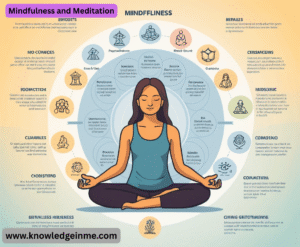
What are Mindfulness and Meditation?
- While often used interchangeably, they are related but distinct concepts.
- Meditation is a broad term for a family of practices designed to train attention and awareness. Think of it as a formal exercise for the mind. There are many types of meditation (e.g., mindfulness meditation, loving-kindness, visualization, mantra).
- Mindfulness is a specific quality of attention—the ability to be fully present and aware of where we are and what we’re doing, without being overly reactive or overwhelmed by what’s going on around us. It is both a type of meditation and a skill you can apply at any moment.
You can think of it like this:
- Meditation is the gym workout (the formal practice).
- Mindfulness is the strength and flexibility you gain from working out, which you then use in your daily life (playing sports, carrying groceries).
Core Principles of Mindfulness
Mindfulness involves cultivating a particular type of awareness characterized by:
- Paying Attention On Purpose: Deliberately directing your focus to the present moment, rather than letting your mind wander on autopilot.
- Being in the Present Moment: Not dwelling on the past or worrying about the future, but engaging with the “here and now.”
- Non-Judgmentally: This is the most crucial and challenging part.
Proven Benefits
Decades of scientific research have shown that a consistent practice can lead to significant benefits for both mental and physical health:
Mental & Emotional Benefits:
- Reduced Stress & Anxiety: Lowers cortisol (the stress hormone) and helps break the cycle of anxious rumination.
- Improved Focus & Concentration: Strengthens your ability to sustain attention and avoid distractions.
- Decreased Symptoms of Depression: Helps prevent relapses into depression by changing your relationship with negative thoughts.
- Increased Self-Awareness: Helps you understand your own patterns of thinking and behaving.
Physical Benefits:
- Lower Blood Pressure: Promotes relaxation of the blood vessels.
- Improved Sleep: Calms the racing mind that often leads to insomnia.
- Boosted Immune Function: Reduces stress-related inflammation.
- Pain Management: Changes the brain’s perception of pain, reducing its intensity.
How to Get Started with Practice
- You don’t need special equipment or hours of free time. Start small and be consistent.
Formal Meditation (The Practice)
- This is setting aside dedicated time to practice.
- Basic Mindfulness of Breath Meditation:
- Sit Comfortably: Find a quiet spot Keep your back straight but not rigid.
- Set a Time: Start with just 5 minutes. Use a timer so you’re not tempted to check the clock.
- Focus on Your Breath: Bring your attention to the physical sensation of your breath.
- Notice When Your Mind Wanders: Your mind will wander. This is not a failure; it is the entire point of the practice. The moment you realize you’ve been lost in thought is a moment of mindfulness.
- Gently Return: When you notice your mind has wandered, gently and without judgment, return your focus to your breath. Do this again and again.
Informal Mindfulness (Bringing it into Daily Life)
- This is about applying that non-judgmental awareness to everyday activities.
- Mindful Eating: Eat one meal a day without distractions (no phone, TV, or reading).
- Stop what you are doing.
Take a breath.
- Observe what you are feeling in your body and mind.
- Proceed with more awareness.
- Common Challenges & Misconceptions
- “I tried it once and I was bad at it.” If you breathed and noticed your mind wandering, you succeeded!
- “I don’t have time.” Even one minute of consciously connecting with your breath can reset your nervous system. You can find one minute.
- “It feels weird/awkward/boring.” This is normal, especially at first. Approach it with curiosity about your own experience, even the boredom.
Helpful Resources
- Apps: Head space (great for beginners), Calm (meditations and sleep stories), Waking Up (more philosophical depth), Insight Timer (large free library).
Beyond the Basics: A Deeper Dive
Types of Meditation
- While mindfulness of breath is a foundational practice, there are many other forms to explore:
- This builds profound body awareness and is excellent for releasing physical tension and aiding sleep.
- Loving-Kindness Meditation (Metta): This practice involves directing feelings of goodwill, kindness, and warmth toward yourself and others by silently repeating phrases like “May I be happy.
- You then extend these wishes to loved ones, neutral people, difficult people, and finally all beings.
- Walking Meditation: A formal practice where you walk slowly and deliberately, fully synchronizing your breath with your steps and focusing on the sensations in your feet and legs. It’s meditation in motion.
- Mindful Listening: Meditating by focusing on sounds in your environment—a fan, birds chirping, distant traffic—without labeling or judging them, just receiving them as pure sensation.
The Neuroscience: How It Changes Your Brain
- Research using fMRI and EEG scans shows that meditation isn’t just a feeling; it physically changes the brain’s structure and function, a concept known as neuroplasticity.
- Prefrontal Cortex: This area, responsible for higher-order functions like decision-making, focus, and emotional regulation, becomes thicker and more active. This is like strengthening the brain’s “CEO.”
- Amygdala: This is the brain’s fear center, triggering the “fight-or-flight” response. With regular practice, the amygdala shrinks and shows decreased activity, making you less reactive to stress.
- Hippocampus: This region, critical for memory and learning, shows increased gray matter density, potentially improving memory function.
- Default Mode Network (DMN): This brain network is active when our mind is wandering, ruminating, and thinking about ourselves (the “monkey mind”). Meditation is shown to quiet the DMN, which correlates with reduced anxiety and a quieter, less distracted mind.
- These changes physically underpin the benefits we feel: better focus, calmer reactions, and increased resilience.
Navigating Common Challenges
Let’s address specific struggles with practical solutions:
- Challenge: “I fall asleep.”
- Why: This is common if you’re sleep-deprived or relaxing deeply for the first time.
- Solution: Try meditating at a different time of day (not right after waking or when exhausted). Sit upright instead of lying down. Open your eyes slightly. Or, simply view it as your body needing rest.
- Challenge: “I get bored or restless.”
- Why: The mind is addicted to stimulation. Boredom is its protest.
- Solution: Get curious about the boredom itself. What does it feel like in the body? Where is the restlessness? Observe it as a passing phenomenon.
- Challenge: “I feel emotional or uncomfortable sensations.”
- Why: As the body relaxes, stored emotions and tension can surface. This is a sign of release, not something going wrong.
- Solution: Practice the core principle of non-judgment. It feels like tightness in my chest.” Breathe into the sensation. If it becomes too intense, gently return to the breath as an anchor.
- Why: We prioritize what feels urgent, not what is important.
- Solution: Anchor your habit. Tie your practice to an existing routine (e.g., “after I brush my teeth in the morning, I will meditate for 5 minutes”). Use an app for reminders and a sense of progression. Focus on consistency, not duration. One minute every day is far more powerful than 30 minutes once a month.
Mindfulness in Action: Real-World Applications
- This isn’t just for sitting on a cushion. It’s a tool for life’s difficult moments.
- Before a High-Pressure Meeting: Take 60 seconds to feel your feet on the floor and follow three full breaths. This grounds you and clears the mental clutter.
- When Feeling Overwhelmed: Practice the STOP method mentioned earlier. This creates a crucial pause between the stimulus and your reaction.
- During Conflict: When you feel anger rising, bring attention to the physical signs (clenched jaw, hot face). This self-awareness creates space to choose a more thoughtful response instead of reacting impulsively.
- While Consuming News/Social Media: Check in with yourself. How is this making me feel? Anxious? Angry? Informed? This allows you to consciously choose your consumption rather than being pulled into a doomscroll.