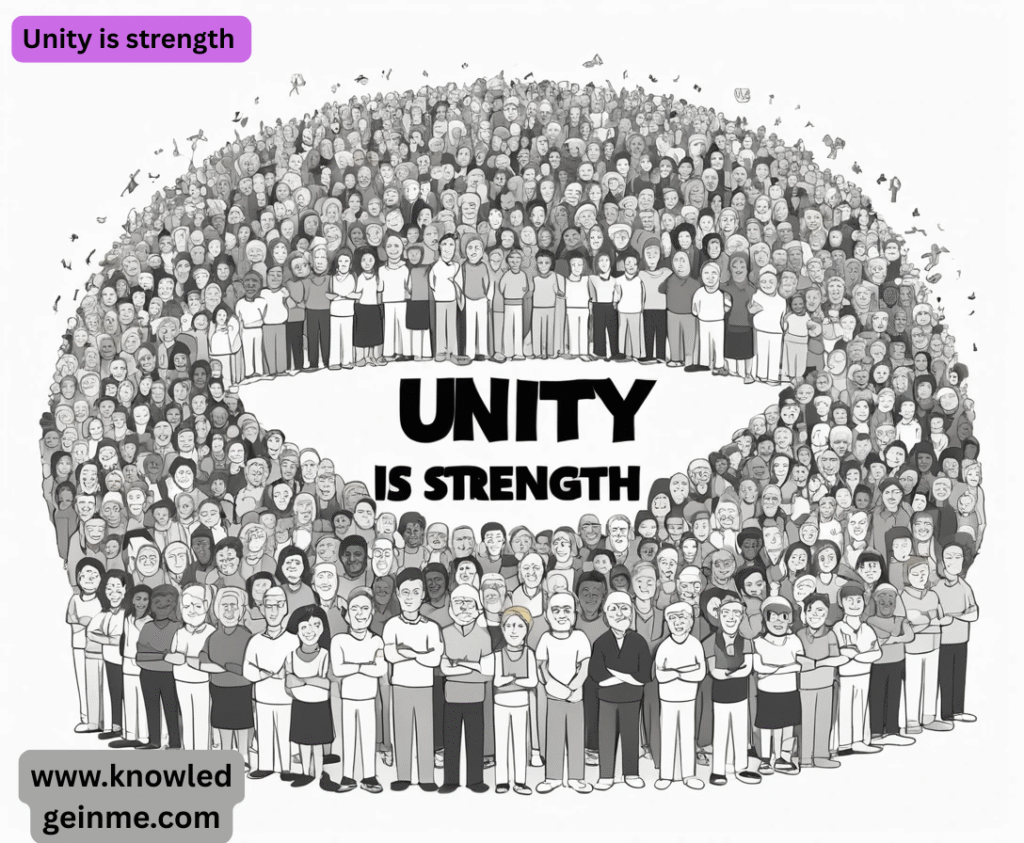

Unity is strength That’s a very powerful and true statement. “Unity is strength” is a proverb that holds across cultures, nature, and every aspect of human end eavor. It means that we are far more powerful, resilient, and effective when we work together as a group than we could ever be alone. Here’s a breakdown of why this idea is so profound:
In Nature (A Bundle of Sticks)
- The most famous illustration comes from an Aesop’s fable. An old man, on his deathbed, shows his quarreling sons the power of unity. He asks each son to break a single stick, which they do easily. He then ties many sticks into a bundle and asks them to break the bundle. None can.
Society and Community
- Problem-Solving: Complex problems like climate change, poverty, or building infrastructure require the collective skills, knowledge, and resources of many people.
- Safety and Support: Communities provide a safety net. They offer help during crises, support in times of grief, and celebration in times of joy.
- Diversity of Thought: A unified group brings together different perspectives, leading to more creative and robust solutions than any one person could devise alone.
the Workplace
- A successful business relies on different departments (engineering, marketing, sales, support) working in harmony toward a common goal. When teams are siloed and compete internally, the whole organization suffers. When they are unified, they achieve far more.
Movements and Social Change
- The Important Flip Side: Unity vs. Conformity
- It’s crucial to distinguish true unity from forced conformity.
- Unity is about aligning on a common purpose or goal while still valuing individual strengths, ideas, and identities. It’s harmony, not uniformity.
- True strength comes from unity that respects and harnesses diversity, not from everyone being exactly the same.
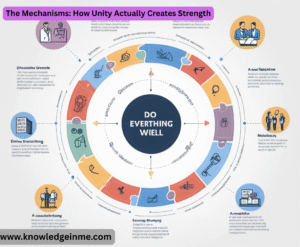
The Mechanisms: How Unity Actually Creates Strength
Unity isn’t just a feeling; it operates through concrete mechanisms:
- Synergy (The Whole is Greater than the Sum of Parts): This is the core principle. A team of diverse experts (e.g., an engineer, a designer, and a marketer) can create a product that none could create alone. Their combined output is multiplicative, not just additive.
- Division of Labor and Specialization: Unity allows for efficiency. Instead of one person struggling to do everything passably well, a unified group can divide tasks according to each member’s strengths. This is the foundation of every successful company and civilization.
- Risk Pooling and Shared Burden: A challenge that would crush an individual becomes manageable when shared. This applies to financial risk (like insurance or investment pools), physical labor (building a barn), and emotional trauma (grief support groups). The burden is distributed, making it lighter for all.
- The Shield Effect: A unified group can protect its members from external threats. This ranges from a school of fish confusing a predator to a union protecting workers’ rights to a nation defending its citizens.
The Psychology: Why We Unify
Our brains are wired for unity. It’s an evolutionary survival tool.
- In-Group Bonding: Oxytocin, the “love hormone,” reinforces bonds and promotes trust and cooperation within a group. Shared experiences, rituals, and goals trigger its release.
- Common Identity: When we shift from “me” to “we,” our perspective changes. We start to see the group’s success as our own success. This shared identity is powerful motivation.
- The Antidote to Fear: Facing a common enemy or a daunting challenge is a classic and powerful unifying force. It forces individuals to set aside minor differences to confront a larger threat.
The Obstacles: What Breaks Unity
Understanding strength also means understanding fragility. Unity is broken by:
- The “Othering” of Internal Members: This is the most common poison. When a group starts to turn on itself, creating internal outcasts or scapegoats, it sows the seeds of its own destruction. This is the difference between “us vs. the problem” and “us vs. them within us.”
- Lack of Clear, Common Purpose: A group without a shared goal is just a crowd. Without a “why,” unity dissolves into individual agendas.
- Poor Communication: Misinformation, rumors, and lack of transparency erode trust, which is the glue of unity.
The Dark Side: When “Unity” is Used for Harm
- The principle itself is neutral. Its morality depends on the goal.
- Mob Mentality: A lynch mob is unified, but its strength is directed toward evil.
- Echo Chambers & Groupthink: Unquestioned unity can suppress critical thought, leading to disastrous decisions (e.g., the Bay of Pigs invasion). The pressure to conform overrides the ability to see flaws.
- Xenophobia and Nationalism: The strongest forms of unity are often built by defining a common enemy. This can easily spiral into hatred and violence against outsiders.
Cultivating True Unity
- Genuine, productive unity doesn’t happen by accident. It’s built:
- By Celebrating Diversity: True unity isn’t about everyone being the same. It’s about everyone bringing their unique strength to the table to serve the common purpose.
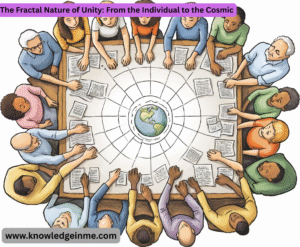
The Fractal Nature of Unity: From the Individual to the Cosmic
Unity operates at every scale of existence, each layer reinforcing the others:
- Internal Unity (The Integrated Self): Before there can be group unity, there must be individual coherence. This is the struggle between our conflicting desires, logic, and emotions. A person at war with themselves is weak. Strength comes from integrating these parts into a harmonious whole. This is the realm of psychology and mindfulness.
- Interpersonal Unity (The Bond): The connection between two people—friends, partners, a mentor and student. This is the fundamental building block of all larger social structures. Trust forged here becomes the template for broader cooperation.
- Group Unity (The Team/Tribe): This is the most common interpretation—a company, a sports team, a community.
- Societal Unity (The Civilization): The complex, often fragile, unity of laws, culture, and shared identity that allows millions of strangers to coexist and collaborate. Money, language, and religion are all tools of societal unity.
- Ecological Unity (The Web of Life): No organism exists alone. The strength of an ecosystem lies in the incomprehensibly complex unity of its biodiversity. Pollinators need flowers, predators need prey, forests create their own rain. This is the ultimate expression of unity: a system where the existence of one is contingent on the existence of all.
- Cosmic Unity (The Physical Fabric): Physics suggests that at the most fundamental level, the universe is a unified, entangled whole. This is the deepest, most abstract layer of the principle.
The Pragmatics of Unity: It’s a Verb, Not a Noun
- Unity is not a static state to be achieved; it is a dynamic process to be maintained. It requires constant work:
- The Necessity of Conflict: True unity is not the absence of conflict. A group that never argues is a group that is avoiding important issues. The strength lies in the repair, not in never breaking.